Sunday, October 17, 2010

Never Let Me Go

Movie name: Never Let Me Go
Year of release: 2010
Director: Mark Romanek
Stars: Carey Mulligan, Andrew Garfield, Keira Knightley, Charlotte Rampling, Sally Hawkins, Izzy Meikle-Small, Charlie Rowe, Kate Bowes Renna
Genre: Drama
Score out of ten (whole numbers only): 7

Synopsis:Mark Romanek has established himself as a commercials and music videos director, before embarking in his film-making path. His first film "One Hour Photo" with Robin Williams and Connie Nielsen was an interesting look into the alienation of one person. He was next going to tackle "The Wolfman", but after disputes with the studio, he abandoned that project and embarked on "Never Let Me Go", based on the book by Kazuo Ishiguro (who also wrote "The Remains of the Day", brought to the screen in 1993 with the direction of James Ivory). The film follows the story of three friends, Kathy, Tommy and Ruth. We're introduced to them as children, living and attending a private school. Kathy and Tommy form a bond that Ruth, out of jealousy, tries to break by starting to court and ultimately developing a relationship with Tommy when they are both older. There is a sense of doom in the lives of these young men and women, as Kathy narrates her and her friends story.
The film has a pace that is contemplative, but also allows for the characters to be understood, particularly Kathy, the narrator and main focus of the film. The bleak premise of the film, makes her a perfect conducting figure, since she seems to be so at peace with herself. Her anguish for knowing that Tommy isn't with her, when he's the one she knows belongs in her life, dissipates as she matures and begins a different phase in her life. When they do get back together, there's a sense of completion and acceptance in her life. The film is nonetheless quite tragic in what it displays. Even if the story is somewhat implausible, the touching (and fantastic) performance from Carey Mulligan does echo throughout the entire film. The cinematography and attention to details in the shots, are a proof that Mark Romanek knows that in a story such as this, the small things mean so much. A film worth watching.

Red

Movie name: Red
Year of release: 2010
Director: Robert Schwentke
Stars: Bruce Willis, Morgan Freeman, John Malkovich, Helen Mirren, Mary Louise Parker, Brian Cox, Karl Urban, Rebecca Pidgeon, Richard Dreyfuss, James Remar, Ernest Borgnine, Audrey Wasilewski
Genre: Action, Comedy
Score out of ten (whole numbers only): 6

Synopsis:Robert Schwentke has made a name for himself thus far with two films that were hits at the box office, namely "Flightplan" with Jodie Foster and "The Time Traveler's Wife" with Rachel McAdams. "Red" is an adaptation of a graphic novel by Warren Ellis and Cully Hamner and it stands for "Retired and Extremely Dangerous" (as in operatives of the CIA who are retired). The film follows Frank Moses, an ex-military man, who lives by himself and who calls Sarah Ross, a social security worker, every month concerning his pension, just in the hopes of talking with her and potentially asking her out. His plans are thwarted when he suddenly becomes the target for an assassination plot, alongside Sarah, whom he has to pick up and keep safe in order to discover who is behind the attempts to have them both killed. Along the way, he seeks the aid of his former friends, also retired operatives.
The major strength of this film is obviously the fantastic cast that Robert Schwentke has assembled: every single actor is more than accomplished and it's a delight to see them bring to life characters that are little more than cliches. But, they do relish and have fun with the roles and the film embarks in a tone that can best be described as light comedic with a strong action undercurrent. The tone of the film is very much coherent with the graphic novel style, but where it does earn extra points is in the fact that it adds a light and comedic tone to it. The actors are of course uniformly good, from Bruce Willis, to Mary Louise Parker to the award winning ones like Morgan Freeman, Helen Mirren and of course John Malkovich who is always a treat. A hightlight goes to Florian Balhaus, the cinematographer, son of the fantastic (and retired) Michael Balhaus, who is a fantastic cinematographer. An entertaining film worth watching.

Wednesday, October 13, 2010

Sunday, October 10, 2010

The Social Network

Movie name: The Social Network
Year of release: 2010
Director: David Fincher
Stars: Jesse Eisenberg, Andrew Garfield, Justin Timberlake, Armie Hammer, Max Minghella, Joseph Mazzello, Rooney Mara, John Getz, Rashida Jones, David Selby, Brenda Song
Genre: Drama
Score out of ten (whole numbers only): 9

Synopsis:By now David Fincher's name is well established as one of the most interesting film-makers currently working. His name is associated with films that are daring, well written and impeccably thought and executed. After the fantastic films that were "Zodiac" and "The Curious Case of Benjamin Button", Fincher decided to tackle a contemporary story, with a screenplay from Aaron Sorkin (who made his name as the creator/writer of "The West Wing"), about the creation of the huge behemoth site that is "Facebook".
The film introduces us to Mark Zuckerberg, a young student at Harvard, who is quite brilliant, but has problems relating to others and developing friendships. Mark's ingenious and brilliance as a programmer, gets him in contact with three individuals who want to create an online network for people who are within the circle of Harvard University. However Zuckerberg goes a step beyond and starts creating something that expands to other universities, including institutes all around the world. In the process this network starts getting more and more attention, from the people who initially hired him and want part of the gain and from Sean Parker, creator of Napster who can see the potential that the project has. In the middle of all this, his friendship with Eduardo Saverin, his initial financial backer crumbles.
David Fincher's film has an energy that is relentless - the film goes through different time frames and different perspectives, in an attempt to understand how the site got launched and the issues that were created as a consequence of it. The multiple lawsuits that Zuckerberg goes through, start peeling away the whole genesis of the site, but ultimately provide some insight to whom those people/intervenients are. The film is built upon layers, with each one providing some further knowledge of why the site is so controversial. In the end, it proves that greed is indeed a main motivating party for a lot of these people. The film has great performances from Jesse Eisenberg, Andrew Garfield and Rooney Mara, who in the few scenes she has, gives a gravity and strength to the role that resonate throughout the entire film. Also to highlight the beautiful cinematography from Jeff Cronenweth. A fantastic film!

Wednesday, October 6, 2010

Let Me In

Movie name: Let Me In
Year of release: 2010
Director: Matt Reeves
Stars: Kodi Smit-McPhee, Chloë Grace Moretz, Richard Jenkins, Cara Buono, Elias Koteas, Sasha Barrese, Dylan Kenin, Chris Browning, Ritchie Coster
Genre: Action, Horror, Sci-Fi
Score out of ten (whole numbers only): 7

Synopsis:Matt Reeves first made his name with the film "The Pallbearer", which starred Gwyneth Paltrow in 1996. Since then he has been a collaborator of J. J. Abrams with whom he worked on the successful TV show "Felicity" and the monster film that was "Cloverfield". "Let Me In", basically follows the screenplay from John Ajvide Lindqvist - in a small town in New Mexico, lonely young Owen sees his life changed by the arrival of new neighbors, in particular of the intriguing Abby, a 12 year old girl who only shows up at night. Owen and Abby strike a good friendship, with Abby providing counseling on how Owen should deal with bullies and Owen introducing her to a series of toys and assorted candy. Owen finds out that there's a lot more to Abby than it's apparent.
Matt Reeves attempted to create his interpretation of the screenplay of John Ajvide Lindqvist - he transposed the story to New Mexico in 1983 and displayed more of the vampiric/monstrous side of Abby. The film ends up being simultaneously similar and different from "Let the Right One In": Matt Reeves is a talented film-maker and directs the film with an attention to detail that certainly gives his film the difference and distance from the original swedish version. Even though the events and how the story progresses are very similar in the two films, the dynamics between the actors feels more developed as does some of the action scenes that populate the film. A good remake, worth watching!

Låt den rätte komma in/Let the Right One In

Movie name: Låt den rätte komma in/Let the Right One In
Year of release: 2008
Director: Tomas Alfredson
Stars: KÃ¥re Hedebrant, Lina Leandersson, Per Ragnar, Henrik Dahl, Karin Bergquist, Peter Carlberg, Ika Nord, Mikael Rahm
Genre: Drama, Mystery, Fantasy
Score out of ten (whole numbers only): 8

Synopsis:Oscar is a young and lonely boy who lives with his mom in a suburb of Stockholm. One evening Oscar notices the arrival of new neighbors, who end up living in the apartment right next to his. The neighbors, an older gentleman and a young girl, are rarely to be seen, but Oscar strikes an unusual friendship with the young Eli who only comes out to play at night. As Oscar tries to know more about Eli he becomes more and more suspicious that there's more to her than meets the eye.
Tomas Alfredson shot "Let the Right One In" from an adaptation of the book with the same name by John Ajvide Lindqvist, also responsible for the screenplay. The film could have easily descended into the vampire frenzy which is currently on display with the "Twilight" saga, but instead, the film slowly builds the story and introduces the characters, before presenting it's more fantastical elements. The director smartly chooses to suggest more than to show - the viewer knows who Eli is and what she has to do to survive, but the film never falls trap of showing the more horrific moments. The relationship between the two young children are the center stage and that is shot so delicately and so candidly - their warmth and tenderness burns through the cold air of the Winter that surrounds them. The film is intelligent in it's choices and ends up being a very good film, always rewarding upon multiple viewings.

Sunday, September 19, 2010

Natural Born Killers

Movie name: Natural Born Killers - The Director's Cut
Year of release: 1994/2009
Director: Oliver Stone
Stars: Woody Harrelson, Juliette Lewis, Robert Downey Jr., Tommy Lee Jones, Tom Sizemore, Arliss Howard, Rodney Dangerfield, Pruitt Taylor Vince, Russell Means, O-Lan Jones, Evan Handler, Balthazar Getty, Joe Grifasi
Genre: Action, Crime, Drama
Score out of ten (whole numbers only): 8

Synopsis:By the time "Natural Born Killers" came out, Summer of 1994, Oliver Stone was already a celebrated director. The 80s saw him winning Oscars for films that were iconic and who definitely had a strong point of view, namely "Salvador", "Platoon", "Wall Street" and "Born on the Fourth of July". The 90s proved to be more hit or miss with the director, but he started out with a great film, "JFK" that again proved what a controversial and artistically driven director he is. He had some misses with "Heaven and Earth", "The Doors" and to a certain extent, "Any Given Sunday", but "Natural Born Killers" easily stands out as one of his most controversial films (and to date, one of his best). The film follows the love story of two young serial killers of sorts, Mickey and Mallory Knox. Both these characters cause mayhem and destruction, till they get caught and sent to prison. The media circus that follows turns them into big stars. Following an interview in prison with shock host, Wayne Gale, both Mickey and Mallory attempt a final escape into freedom.
Oliver Stone used as a premise a story written by Quentin Tarantino (who said that the film was nothing like what he had intended), but he took it far beyond that. If the story was originally conceived as a different version of "True Romance" or "Bonnie and Clyde", Oliver Stone painted a larger canvas. The film turned out to be more a metaphor for our celebrity obsessed society, for a generation who glamorized television above everything, where the notions of good and bad are warped, where the 15 minutes of fame mean everything. Oliver Stone used his kinetic editing process, mixing different types of film, animation, video, to create a mosaic of images that bombard the characters (and us) at all times. The film polarized opinions because many thought it glorified violence, but the director clearly set out to do the opposite - behind that whole violence there's an irony of how television embraces it and mixes it to make everything more acceptable to standard palates. In the end, the film clearly states that everyone embraces anything that TV presents, the utmost violence, as long as the viewers keep watching. The film to this day, makes it's point loud and clear, with the plethora of reality-TV shows that are on the networks. Oliver Stone had many problems with censorship, but the recently released uncut version, allows to see the film in it's original version. It also allows to see the fantastic performances of Juliette Lewis and Robert Downey Jr. A fantastic film worth watching!

Saturday, September 11, 2010

Io Sono L'amore/I Am Love

Movie name: Io Sono L'amore/I Am Love
Year of release: 2009
Director: Luca Guadagnino
Stars: Tilda Swinton, Marisa Berenson, Flavio Parenti, Edoardo Gabbriellini, Alba Rohrwacher, Diane Fleri, Maria Paiato, Pippo Delbono, Gabriele Ferzetti, Mattia Zaccaro
Genre: Drama
Score out of ten (whole numbers only): 9

Synopsis:Luca Guadagnino and Tilda Swinton have a relationship that goes back quite a few years. They have done "The Protagonists" together and "Tilda Swinton: The Love Factory". "Io Sono L'Amore" is very much an opulent melodrama based in the tradition of Luchino Visconti's films. The film follows Emma Recchi, a Russian woman who married a rich Italian industrialist, with whom she has had 3 children. The family is on the verge of change, since the patriarch of the family is dying and he is leaving control of the empire to his son and eldest grandson. Emma lives her life quietly and peacefully, trying to be a good understanding mother to her children and a good wife for her husband. One of her son's friends, Antonio, enters the storyline, as both of them decide to open a restaurant. Antonio, finds Emma irresistible and soon they become in love. This love affair produces unexpected results in Emma's and her family's lives.
Luga Guadagnino's talent is on display in this beautiful film, that takes the time to introduce us to this bourgeois family, where the luxury is clearly on display and where the family dynamics are all too apparent. There is a tranquility in the way these lives are led, but there's also a constraint in all this serene contemplation of living. Emma clearly longs for love, something she finds in a much younger man, who creates a spark in her life, something that burns away everything she has. Her children are all grown, all of them finding their own paths in life and even in the tragedy that occurs, the path and motions that have been set forth, can not be denied. This is a film that treasures the details, revisiting the style of Italian drama of the 50s and 60s, but with a contemporary feel, something that the ravishing cinematography and soundtrack undeniably help achieve. Tilda Swinton creates a fantastic character, with her serene beauty, that is destroyed by pain and uplifted by love. This is her film, through and through. A fantastic film.

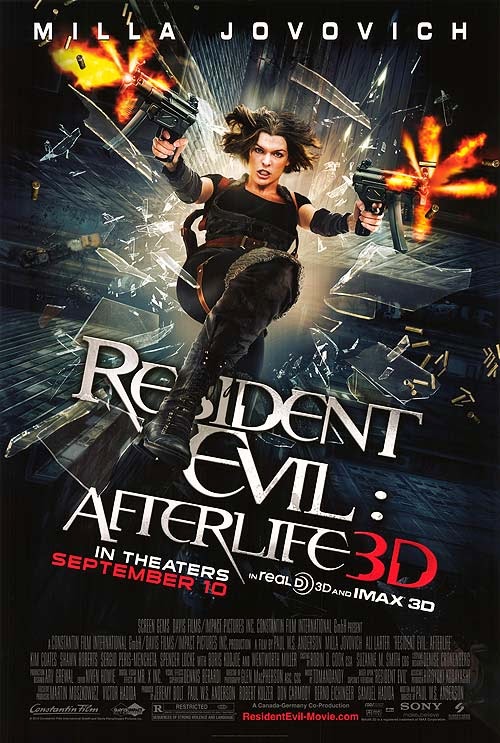
Resident Evil: Afterlife

Movie name: Resident Evil: Afterlife
Year of release: 2010
Director: Paul W. S. Anderson
Stars: Milla Jovovich, Ali Larter, Wentworth Miller, Kim Coates, Shawn Roberts, Spencer Locke, Sienna Guillory, Kacey Barnfield, Boris Kodjoe, Sergio Peris-Mencheta
Genre: Action, Horror, Sci-Fi
Score out of ten (whole numbers only): 4

Synopsis:Paul W. S. Anderson has made a name for himself with action films. His first film, the violent and underrated "Shopping", made in his native UK with a young Jude Law, promised a different path, but the director has since embarked in bigger budget sci-fi extravaganzas, namely "Event Horizon", "Soldier" and "Alien vs. Predator". "Resident Evil" has been a very popular video game and Anderson directed the first film of the series and has since then taken creative control over the films that have been thus far produced. "Resident Evil: Afterlife" sees Paul W.S. Anderson in the director chair, after the previous ones were directed by Alexander Witt and Russell Mulcahy (with mixed results). The film follows Alice (the ever resilient Milla Jovovich) and her clones, taking on the Umbrella Corporation in Japan. Her main opponent, the head of Umbrella, has also been genetically altered by the Virus and manages to infect Alice with a substance that makes her human again. Alice flees Japan in an attempt to go to Alaska, where her friends had gone, to a place named Arcadia. Upon her arrival she soon discovers that things are much different than she anticipated.
The film and it's sequels, are all anchored in action set pieces that make the main characters move towards their goal - a safe haven where there are no zombies. If the zombie genre was always used as a metaphor to expose the problems of our society, that was the tradition of the master of the genre George Romero, the "Resident Evil" series takes the more straightforward road. The goal is to keep the characters moving, trying to destroy opponents and somehow reach a utopia that doesn't seem to exist. The concept of the greedy corporation is still there, the omnipresent Umbrella corporation, but the whole choreography of the action and special effects have surpassed the spirit of a genre that was always about being subversive (and entertaining of course). As is, "Resident Evil: Afterlife" manages to be better than it's two previous sequels, in the sense that the director clearly relishes these characters and creates action sequences that are well thought and executed. It's industrial film-making at it's peak. Milla Jovovich continues her path as the action heroine, but that's all that can be said - there is no nuance here (both film and acting in general).

Centurion

Movie name: Centurion
Year of release: 2010
Director: Neil Marshall
Stars: Michael Fassbender, Dominic West, Olga Kurylenko, David Morrissey, Imogen Poots, Noel Clarke, Lee Ross, Ulrich Thomsen
Genre: Action, Adventure
Score out of ten (whole numbers only): 5

Synopsis:Neil Marshall has built a name for himself with two films, "Dogsoldiers" and "The Descent", both suspense/thrillers with fantastic components. "Doomsday" was a mix of "28 Days Later" and "Mad Max" and though entertaining, it did not expand his universe or garnered him more accolades. "Centurion" is an action film, that takes place in Northern Britain, when the Roman Empire is trying to hold off their opponents, the Picts. The film follows Quintus Dias, the sole Roman survivor of a Pict attack to a Roman fort. The Roman Empire is trying to strengthen their position in that area and for that effect they send the tough 9Th Legion to tackle their barbarian opponents. Quintus Dias attempt to flee his captors and the 9Th Legion thirst for battle meet up in the field, with unexpected results.
Neil Marshall has built a career of writing and directing stories where the action and violent components are always very present. His heroes are at odds with a stronger and sometimes almost impossible opponents, yet in the end they always vanquish. The Roman Empire setting, allows him to change his scenario and to shoot the brutal battle scenes with a ferocity and realism that is quite impressive. The downfall of the film turns out to be the cliches that it encounters, with the running group, the lonely and beautiful witch that takes them in, the dangerous pursuers. The film has very good moments, but it's time for Neil Marshall to expand his screenplays a bit more and allow for more character development. An interesting film.

Sunday, September 5, 2010

Hable con Ella/Talk to Her

Movie name: Hable con Ella/Talk to Her
Year of release: 2002
Director: Pedro Almodovar
Stars: Javier Camara, Dario Grandinetti, Leonor Watling, Rosario Flores, Mariola Fuentes, Geraldine Chaplin, Elena Anaya
Genre: Drama
Score out of ten (whole numbers only): 9

Synopsis:Following the huge critical and audience success of "Todo Sobre mi Madre", Almodovar returned in 2002 with "Hable con Ella", another crowning achievement in his career. The film earned him an Oscar for best original screenplay and a nomination for best director. "Hable con Ella" crosses the stories of Benigno a male nurse, who is caring for Alicia, a beautiful young ballerina who has been in a coma for years and Marco, a journalist whose lover, Lydia, a bullfighter, is also taken to the same clinic after a serious incident. Benigno lives in the hopes that Alicia will come back, so they can embark on a relationship, whereas Marco knows that Lydia has her heart set upon someone else.
"Hable con Ella" is in a way a continuation of all of Almodovar's themes, but it is also one of his most sophisticated and elaborate film. The film is anchored by male characters, but all of them are entranced by their female partners - Benigno and Marco are both prisoners of their love for women who are for all intended purposes, beyond their reach. Their medical comas make them more unreachable, since they become ideal versions of femininity for both men. Almodovar shoots this film with surrealistic tones, mixing also the beauty of dance with the gorgeous tunes of Caetano Veloso. The acting is fantastic, with the highlight going to Javier Camara who creates a wonderful character in Benigno, filled with an enthusiasm, faith and warmth - even his flaws only make him grander and more heartbreaking. A fascinating film from a master.

Todo Sobre Mi Madre/All About My Mother

Movie name: Todo Sobre Mi Madre/All About My Mother
Year of release: 1999
Director: Pedro Almodovar
Stars: Cecilia Roth, Marisa Paredes, Penelope Cruz, Candela Pena, Antonia San Juan, Rosa Maria Sarda, Toni Canto, Eloy Azorin
Genre: Drama
Score out of ten (whole numbers only): 10

Synopsis:"Todo Sobre Mi Madre" is, so far, the film from Almodovar who has possibly garnered the most accolades in his career. The film won the Oscar for best foreign picture and went on to win some other 47 awards (amongst acting, writing and other categories). The film continued to illustrate his return to form, that would again be repeated with the fantastic "Hable con Ella" of 2002. The film is centered in women and uses Tennessee Williams' "A Streetcar Named Desire" as a unifying theme. Manuela is strong single mother who dramatically loses her son one night. She decides to go to Barcelona to seek out the father of her son, whom has been estranged for so many years. Upon her arrival, she reconnects with some old friendships, namely Agrado a prostitute, whom she knew from when she lived in Barcelona. She also becomes acquainted with Huma, an actress and Rosa, a nun, who coincidentally may have news about her long forgotten husband.
"Todo Sobre Mi Madre" owes much to the classic Hollywood melodrama, but it transcends it since Almodovar makes it his own. His universe, colorful as is, is inhabited by strong women, who unite in moments of despair, one where men are the source of problems, but without whom there's no joy of living. This film in particular manages to perfect all the touches that Almodovar has created all throughout his career - the intersecting story lines, the humor, the surreal side of life, the drama of every day, without making it look trivial or common. The acting is, as always fantastic, particularly from Cecilia Roth, Marisa Paredes and Penelope Cruz. A fantastic achievement.

Carne Tremula/Live Flesh

Movie name: Carne Tremula/Live Flesh
Year of release: 1997
Director: Pedro Almodovar
Stars: Francesca Neri, Javier Bardem, Liberto Rabal, Angela Molina, Jose Sancho, Penelope Cruz, Pilar Bardem
Genre: Drama, Thriller
Score out of ten (whole numbers only): 8

Synopsis:While the early 90s were a bit irregular in terms of quality, with many critics accusing Almodovar of just repeating himself, by the mid 90s the director experienced a new return to his more unique work, which started with "La Flor de mi Secreto" and particularly with "Carne Tremula/Live Flesh" that garnered him strong reviews. Adapting for the first time a novel, Almodovar tackled Ruth Rendell and came out with a darker thriller, populated with his taste for intersecting story lines and a mosaic of characters well defined in their pursuits.
The film follows Victor, a young man who crosses paths with Elena a young troubled woman in less than honest activities. After a confrontation with the police, Victor ends up being sent to jail, whereas Elena ends up marrying the police officer who captured Victor (and who was left a paraplegic due to it). Upon Victor's release, he sets out to restart his life, yet finds himself crossing paths with Elena and her husband, David.
"Carne Tremula" though adapted from a novel, is very much an Almodovar film. The center stage is occupied by Victor, but the dynamics come from all the women who populate the story. Elena who draws men to her and who learns how to connect with the man she loves and wants and Clara who walks away from a brutal marriage with a coward of a man. The intersecting narrative threads, as usual in Almodovar, weave a story that is very much a part of Madrid and Spain - another of the director's traits. The acting is as usual superb, particularly Javier Bardem who is fantastic as David, the resourceful police officer who has to learn to live a new life. A great film.

Saturday, September 4, 2010

Mujeres al Borde de un Ataque de Nervios/Women on the Verge of a Nervous Breakdown

Movie name: Mujeres al Borde de un Ataque de Nervios/Women on the Verge of a Nervous Breakdown
Year of release: 1988
Director: Pedro Almodovar
Stars: Carmen Maura, Antonio Banderas, Julieta Serrano, Maria Barranco, Rossy de Palma, Fernando Guillen, Chus Lampreave, Kiti Manver, Guillermo Montesinos, Loles Leon
Genre: Comedy
Score out of ten (whole numbers only): 9

Synopsis:"Mujeres al Borde de un Ataque de Nervios" marked the first encounter of Pedro Almodovar with Hollywood, in the sense that it became his first film to be Oscar nominated (for best foreign film). It was also the film that finally broke him to the larger audience, bringing an attention to his work like none of his previous films had done thus far. The film follows the life of Pepa, an actress who is going through a meltdown. Pepa's lover has abandoned her through the telephone and Pepa has discovered some shocking news that she needs to share with him. Her ex-lover is cowardly avoiding her and Pepa resorts to checking places she knows he can be, in order to confront him. In one of these outings, Pepa meets the son of his ex-lover, who by coincidence shows up at her apartment wanting to buy it. Adding to this tangled web comes Pepa's best friend, Candela, who has been involved with some less than licit lover.
If Almodovar's films always had a touch of irreverence and humor, "Mujeres al Borde de un Ataque de Nervios" goes full blown in that department. The stage is set, with a tangled web of people crossing paths and losing track of each other. Again the center stage are women, with their relationship problems - Pepa, played fantastically by the energetic Carmen Maura - takes the lead, going through different meltdowns, all in the hopes of keeping her lover, when she is obviously the real dynamo in the relationship. Almodovar creates fantastic characters, always with different details and Pepa is no different - in her need to restore her relationship she ultimately finds something more important - herself. A brilliant comedy.

La Ley Del Deseo/Law of Desire

Movie name: La Ley Del Deseo/Law of Desire
Year of release: 1987
Director: Pedro Almodovar
Stars: Eusebio Poncela, Antonio Banderas, Carmen Maura, Miguel Molina, Fernando Guillen, Nacho Martinez, Manuela Velasco, Bibi Andersen, Fernando Guillen Cuervo
Genre: Drama, Dark Comedy
Score out of ten (whole numbers only): 8

Synopsis:At the peak of his creative writing and directing skills, Almodovar released "La Ley Del Deseo" one year after "Matador". He maintained his team and tackled a story that mirrored his love for film making and the drama from Douglas Sirk 1950s films. The film follows Pablo, a well known and successful film and theater director who is trying to make a relationship with a young man named Juan work. Their relationship is under some strain and following Juan's exit, Pablo gets briefly involved with Antonio, an inexperienced young man, who soon becomes obsessed and possessive with Pablo. Pablo's sister, Tina (a middle aged transsexual), has her own relationship problems and is taking care of young Ada. Antonio changes the dynamics of this group, when he decides that Pablo is his and his alone.
"La Ley Del Deseo" was another triumph for Almodovar, even if a bit scandalous, with it's very frank and graphic sex scenes. Working from his own screenplay, Almodovar utilized the film context (which he uses with some regularity for inspiration), to build a story of sexual longing and of true identity. Antonio who mentions to Pablo at the beginning of the film, isn't gay, becomes a prisoner of his love and desire, whereas Tina lives a life that is a consequence of her desires. All the characters in the story end up carrying the consequences of their own urges and ultimately, of what their love has dictated. No matter how far off reality these characters appear to be, Almodovar always finds a way to anchor them and show just how beneath all the frantic despair, lies a romantic heart. A great film.