Sunday, May 3, 2020

Godzilla: King of Monsters

Movie Name: Godzilla: King of Monsters
Year of Release: 2019
Director: Michael Dougherty
Starring: Kyle Chandler, Vera Farmiga, Millie Bobby Brown, Ken Watanabe, Ziyi Zhang, Bradley Whitford, Sally Hawkins, Charles Dance, Thomas Middleditch, Aisha Hinds, David Strathairn, Anthony Ramos 
Genre: Adventure, Action, Fantasy
Score out of ten (whole numbers only): 2 
Watch it on Amazon

Synopsis and Review:
Following the commercial success of both Gareth Edwards's "Godzilla" and Jordan Vogt-Roberts's "Kong: Skull Island", a continuation of this series with big monsters was bound to continue. The film follows the events of the first "Godzilla" film, as now the world is aware of the existence of Titans. The narrative focuses on the broken family comprised of Dr. Emma Russell, a paleobiologist, Dr. Mark Russell, her ex-husband and their young daughter, Madison. Emma firmly believes these Titans should be unleashed into the world, since only then can the planet battle all the problems caused by humans. Firmly believing this plan, she unleashes "Monster Zero", who goes on to battle Godzilla, all the while other Titans are being reawakened. "Monster Zero" turns out is King Ghidorah, an ancient alien species seeking to terraform the Earth. It's up to Godzilla and its allies to fight this formidable foe, before the entire planet is destroyed.
Crafting an intelligent and compelling monster film is difficult. Steven Spielberg, when adapting Peter Benchley with "Jaws" and Michael Crichton with "Jurassic Park", knew that in order to successfully craft films that held people's attention, it wasn't necessarily the virtuosity of the monster or showcasing much of it all the time, that made these features so iconic. It's the ability to create a human tapestry of characters that are peers in relevance to the monsters onscreen, since they are after all, who we create empathy with. Michael Dougherty who made a name for himself, firstly as a collaborating writer with Bryan Singer's team (he worked on "X-Men2" and "Superman Returns"), sadly never manages to successfully create a film that is sufficiently compelling and ultimately, memorable. The characters are afterthoughts throughout most of the narrative, and witnessing digitally oversized monsters crash and battle each other for stretches of time, isn't something that holds audiences attention. What was so interesting about "Jurassic Park", or even Alfred Hitchcock's "The Birds", was the imminent threat being brought on to the main characters, whose journeys we were invested in. In this film, the characters are barely distinguishable in the middle of all the rubble and noise being created by the monsters. The great cast sadly has nothing much to do, with even the usually excellent Vera Farmiga faring poorly, the same going for Kyle Chandler (who probably should venture out to different roles, since he's worn out the father figure across a variety of films/shows). The visual effects are superb, but sadly even them don't save this film from exhaustion and oblivion. A wasted effort.

Mirror, Mirror

Movie Name: Mirror, Mirror
Year of Release: 2012
Director: Tarsem Singh
Starring: Julia Roberts, Lily Collins, Armie Hammer, Nathan Lane, Mare Winningham, Michael Lerner, Sean Bean, Jordan Prentice, Joe Gnoffo, Mark Povinelli, Danny Woodburn, Sebastian Saraceno, Martin Klebba, Ronald Lee Clark, Robert Emms, Alex Ivanovici
Genre: Comedy
Score out of ten (whole numbers only): 4 
Watch it on Amazon

Synopsis and Review:
Director Tarsem Singh followed his successful "Immortals", with another take on a beloved classic, "Snow White and the Seven Dwarfs", and again in the same year, competing with another project, namely "Snow White and The Huntsman" (which featured a starrier cast, headlined by Charlize Theron, Kristen Steward and Chris Hemsworth, directed by Rupert Sanders). Based on a 19th century German fairy tale, published by the Brothers Grimm in 1812, this adaptation once again follows the tribulations of Snow White, and her defiantly malevolent stepmother, The Queen. The Queen is the narrator of the feature, and through her, we come to know of the kingdom in which the action takes place, and of her marriage to the ruler. The King, a widower, has a small daughter by the name of Snow White. Once the King mysteriously disappears, the Queen takes ownership of the kingdom, and poverty and misery ensues. She also nearly imprisons Snow White, all the while using magic to make sure her beauty remains eternal and unchallenged. However as the finances of the kingdom are in dire need, the Queen starts looking for a wealthy suitor, which comes in the shape of a valiant prince, who while on a quest throughout the lands, is robbed by a pack of men in the woods. While the prince and Snow White accidentally meet, sparks fly, much to dismay and fury of the Queen, who stops at nothing to get her will fulfilled. 
Tarsem Singh is well known for his unique aesthetic, and for his collaborations with phenomenal and sadly deceased, costume designer, Eiko Ishioka. After his passion project, "The Fall", the director tackled more commercial endeavors, starting with "Immortals", quickly followed by "Mirror, Mirror". The film is a lighthearted, comedic take on the "Snow White" mythology, but attempts to do so with some restraint, which assessing from the results, ends up being its biggest issue. The film can't quite find its tone, oscillating between the more slapstick, tongue in cheek humor that Julia Roberts and Nathan Lane try to bring to the film, to the somewhat more restrained, feminist and social aware perspective that is represented by Snow White. The comedic tone is indeed its biggest issue, since the film could have been just as funny without the overt and childlike humor. Sometimes less is indeed more. The characters are merely sketches, with both Snow White and the Queen, being defined by very broad strokes, and not much depth of characterization, the same going for the supporting characters. Where the film ends up being successful is, of course, the production virtuosity, from the stunning costumes of Eiko Ishioka, to the cinematography of Brendan Galvin. The actors are a mix bag, with Nathan Lane as always providing effective comic relief, whereas Julia Roberts is very miscast, sporting an accent that comes and goes. A forgettable endeavor from an interesting stylistic director. 

Sunday, April 26, 2020

American Heart

Movie Name: American Heart
Year of Release: 1992
Director: Martin Bell
Starring: Jeff Bridges, Edward Furlong, Lucinda Jenney, Don Harvey, Tracey Kapisky, Melvyn Hayward, Jayne Entwistle
Genre: Drama
Score out of ten (whole numbers only): 6 
Watch it on Amazon

Synopsis and Review:
Director Martin Bell has made a name for himself mostly as a documentary film maker. "American Heart" was his narrative feature debut, which premiered at the Toronto Film Festival in 1992, and to a larger audience in May of 93 (the same year Jeff Bridges was also in Peter Weir's superlative "Fearless"). The film follows the story of Jack Kelson, who has been released from prison, on a work furlough program. He goes back to Seattle where he reunites with his teenage son, who in the meantime has been living with his aunt. Jack tries to avoid the life of crime, and takes a job as a window washer, while Nick, his son, has problems of his own at school, which prompts him to hang out with other dispossessed kids. Even if the relationship between father and son is rocky at first, they eventually settle on a plan of moving to Alaska and starting a new life there. That is until a series of misfires catches up with them, and crime comes back to gobble Jack up.
"American Heart" is a film that much like Martin Bell's documentaries, attempts to capture the realities of living on the fringe of society. How do people rebuild their lives after going through the prison system. It's also a film about a father and a son trying to build a relationship, with the parental figure initially uncertain of his own role, his legacy and his impact on the life of his offspring. While the film doesn't document uncharted territory, and for the most part, touches on a lot of topics that other films have done in the past (that same year alone, it's interesting to compare this film with Clint Eastwood's "A Perfect World" for instance), it does allow for the actors to stretch and show their range and versatility. The final chapter of this film is also its less successful moment, but the cast makes this story compelling and watchable. Jeff Bridges is, as always, phenomenal in this part, making Jack a multifaceted person, who eventually comes into his own and matures, while Edward Furlong, back then on a upward trajectory, makes Nick a young man filled with questions, but also looking for a path for his own existence. The supporting work from Lucinda Jenney (who made a brief impact on Ridley Scott's "Thelma and Louise") is solid, as is the work from the production team (and a highlight goes to the late iconic photographer Mary Ellen Mark, who photographed the lead actors for the stunning posters that accompanied the release of this film, and who was married to director Martin Bell). A film worth watching.   

Adams Family Values

Movie Name: Adams Family Values
Year of Release: 1993
Director: Barry Sonnenfeld
Starring: Anjelica Huston, Raul Julia, Christopher Lloyd, Christina Ricci, Joan Cusack, Carel Struycken, Carol Kane, Jimmy Workman, David Krumholtz, Dana Ivey, Christine Baranski, Peter MacNicol
Genre: Comedy
Score out of ten (whole numbers only): 6 
Watch it on Amazon

Synopsis and Review:
The critical and commercial success of "The Adams Family" prompted the desire for a sequel which came out a mere two years later, coincidentally in a year where Barry Sonnenfeld had another release, "For Love or Money" (featuring Michael J. Fox). The film picks up from the events from the first feature, but this time around Gomez and Morticia add a baby to their brood. The other children, Wednesday and Pugsley, include him in their habitual playtime, with the intent of eventually killing him, Adams Family style. An additional new player also comes into the family in the shape of Debbie Jellinsky, originally hired as a nanny, but in reality, a Black Widow, who wants to marry Fester and kill the remainder of the family in order to walk away with the family money. Through shrewd manipulation, Debbie sends the older children to Summer camp, and manages to marry Fester. As her constant attempts to kill him, only entice him further, Debbie resorts to drastic plans in order to decimate the Adams clan, while the children at camp are literally throwing that entire experience into disarray.
"Adams Family Values" continues much of what Barry Sonnenfeld had done with the first feature. Working from a script authored by Paul Rudnick, the film finesses the family dynamics, with the introduction of the spirited baby, all the while bringing into the film that true magnet of attention, in the shape of Joan Cusack's Debbie. The phenomenal actress, manages to perfectly encapsulate the whole range of emotions, from sweet, devoted and kind nanny, to lustful seductress, to maniacal, edgy killer, and for all intended purposes, she walk away with the film. Another high point of the feature is Paul Rudnick's twist of the typical All American Summer camp experience, through the eyes of the Adams, making that section of the film one of its funniest bits. Overall it's a film where the parental figures of the family, cede way to the children and to a ravenous killer subplot, while still being present and part of the ecosystem that the previous chapter put in place. Barry Sonnenfeld illustrates the action stylistically, thanks to the beautiful production design from the late Ken Adams, and equally the great cinematography from the late Don Peterman. An entertaining feature worth watching.

Sunday, April 19, 2020

Unforgiven

Movie Name: Unforgiven
Year of Release: 1992
Director: Clint Eastwood
Starring: Clint Eastwood, Gene Hackman, Morgan Freeman, Richard Harris, Frances Fisher, Jaimz Woolvett, Saul Rubinek, Anna Thomson, Rob Campbell, Anthony James, David Mucci
Genre: Drama, Western
Score out of ten (whole numbers only): 8
Watch it on Amazon

Synopsis and Review:
Actor/Producer/Director Clint Eastwood started the 90s with the diptych "White Hunter Black Heart" and "The Rookie", which were met with different levels of accolades, but quickly soared to new levels of accomplishment and critical recognition when "Unforgiven" premiered in August of 1992. The film focuses on the story of William Munny, a retired gunslinger, who now lives on a farm with his children. He's visited by a young admirer by the name of "Schofield Kid", who wants to pursue the bounty placed on two cowboys, who disfigured a young prostitute in a small town by the name of Big Whiskey. He enlists the assistance of a friend, another retired outlaw by the name of Logan. The three of them head for the small town, where the sheriff of the town, the sadistic Bill has already handled a British born gunfighter, and generally keeps the town under his thumb. While in the town's saloon, Bill beats and kicks Munny out, which still doesn't deter him from finding and killing the men whose bounty had originally started this whole odyssey. As his friend Logan, wanting to move away from this life, is killed by Bill, Munny plans out a comeback to Big Whiskey to exact his revenge.
"Unforgiven", much like some of Clint Eastwood's best Westerns, "The Outlaw Josey Wales" and "Pale Rider", is a film peppered with some of his trademarks, but with a substantial difference this time around: unlike the other features, the central character, Munny, is a man who has had his fair share of violence and death, who primarily longs for a peaceful life with his children. The story has the mantle and heavy burden of mortality to it, as the central characters know and realize they're of a certain age, time is catching up with them, and they desperately want to break away from a path that still clings to them. It's also a film that unlike the lightness and adventuresome aspect of Lawrence Kasdan's "Silverado", goes for a grittier and toned down capture of the life of retired outlaws, with meek means of survival, and who simply have to make the best they can with what they have. It's a film with a certain melancholy and nostalgia in tone, with the right amounts of humor. Written by David Webb Peoples (who also wrote Ridley Scott's "Blade Runner", Richard Donner's "Ladyhawke" and Terry Gilliam's "12 Monkeys"), it is also perfectly and deftly shot, courtesy of Jack N. Green, and features all around indelible performances, including Eastwood, the terrific Gene Hackman (who won a series of awards for this role), Morgan Freeman, Richard Harris and Frances Fisher. A great film from a very prolific and talented film maker.

Twin Peaks: Fire Walk with Me

Movie Name: Twin Peaks: Fire Walk with Me
Year of Release: 1992
Director: David Lynch
Starring: Sheryl Lee, Ray Wise, Moira Kelly, James Marshall, Kyle MacLachlan, Peggy Lipton, Grace Zabriskie, Madchen Amick, Dana Ashbrook, Phoebe Augustine, David Bowie, Miguel Ferrer, Chris Isaak, Kiefer Sutherland, Pamela Gidley, Heather Graham, David Lynch, Eric DaRe, Harry Dean Stanton, Lenny Von Dohlen, Frances Bay, Jurgen Prochnow, Michael J. Anderson, Frank Silva, Al Strobel, Catherine E. Coulson
Genre: Drama, Mystery, Horror
Score out of ten (whole numbers only): 8
Watch it on Amazon

Synopsis and Review:
After the ending of the show "Twin Peaks" in 1991, director David Lynch reconvened much of the same team, to essentially write a prequel to the events that took place on the show. Whereas the show was about the shock that permeated across the small community of Twin Peaks, when their young and beautiful prom Queen got murdered, and how everything in that city had an underlying darkness that wasn't immediately visible to the naked eye, the film went back in time and focused on the last 7 days of the life of focus of all attention, Laura Palmer. We're introduced to Laura, and her every day life, which includes going to high school with her best friend Donna, who herself, only knows a very limited amount of what goes on in Laura's life. Laura is dating her classmate Bobby, who is also her dealer, while secretly she has a relationship with James Hurley, another classmate, a sensitive and kind biker who truly loves her. Laura is also secretly escorting to get money for drugs, while shielding, when she can, the sexual abuse of a man by the name of Bob. As Laura and her world starts crashing upon itself, and she uncovers the truth about her years of abuse, the FBI is on a path of their own, where they're investigating the death of young women, which can be traced to Twin Peaks itself.
After winning the Palm D'Or at Cannes in 1990 with the wonderful "Wild at Heart", David Lynch returned in 1992 with "Twin Peaks; Fire Walk with Me", where the film suffered some critical backlash, following the immense success of the first season of the show in which it is based (and the somewhat less accomplished second season, which precipitated the cancellation of the show). Since then the film has been reevaluated, but having seen the film many times since its debut in 1992, it continues to be a film that dazzles and haunts, much like the best films from this director. If the show at its best, was an interesting hybrid of observing the social habits of a small town in America, and what was laying underneath it (much like what "Blue Velvet" had already touched upon), mixed with the oneiric or otherworldly aspect of David Lynch's imagination/universe, the film abandons that balance, opting instead for fully embracing this otherworldly state of existence, where creatures can inhabit humans, influencing their habits and behaviors. The film is a deeper dive to everything that the show had somewhat slightly hinted at, showcasing Laura's life as never before, someone who's been abused, who tries to deal with her pain by numbing it with drugs and a plethora of lovers, who merely see an idolized version of her, and not her real self. It's a film that also, and intently, departs from what the TV show set in motion, opting instead for a rawer approach, abandoning the whole quirkiness of the characters, much like "Northern Exposure". As usual with David Lynch it's a film that asks questions to the viewers, and effectively takes you on a dark journey, one where no character is exactly who they seem to be. The cast of the show is almost all back (save for Lara Flynn Boyle, the original Donna), but Sheryl Lee creates a solid central character, with good support from Kyle MacLachlan, Moira Kelly, Ray Wise and David Lynch himself. The cinematography from Ron Garcia is fantastic as is the score from Angelo Badalamenti. A great film from a unique voice in cinema, always worth revisiting.

Saturday, April 11, 2020

Sister Act

Movie Name: Sister Act
Year of Release: 1992
Director: Emile Ardolino
Starring: Whoopi Goldberg, Maggie Smith, Kathy Najimy, Wendy Makkena, Mary Wickes, Harvey Keitel, Bill Nunn, Robert Miranda, Richard Portnow, Ellen Albertini Dow, Carmen Zapata
Genre: Comedy
Score out of ten (whole numbers only): 5
Watch it on Amazon

Synopsis and Review:
Director Emile Ardolino had a brief feature directorial career that tragically ended in 1993 when he passed away. But up until that moment, he managed to direct a series of successful features, primarily documentaries focused on Dance (which allowed him to win Emmys and an Oscar for best documentary), and feature films which included "Dirty Dancing" and the romantic comedy "Chances Are" (with Cybill Shepherd, Robert Downey Jr. and Mary Stuart Masterson). "Sister Act" turned out to be his biggest hit, eventually going on to elicit a less successful sequel, but nonetheless managing to further establish Whoopi Goldberg's career while launching Kathy Najimy's. The film written by the wonderfully talented Paul Rudnick, follows the story of Deloris Van Cartier, who has a singing act in Reno, Nevada. After she witnesses her gangster boyfriend kill a police informant, she flees and is placed under the Witness Protection program. She's hidden in a convent in San Francisco, under a new identity, that of sister Mary Clarence. Initially frowned upon by the Reverend Mother, Deloris/Mary Clarence starts working with the Choir, and her passion and input start translating into better and bigger performances. These performances in turn start bringing more and more people to church, and they collectively start having an impact in the lives of the community. As the trial of her gangster ex-boyfriend is coming up, Deloris/Mary Clarence gives notice to the Reverend Mother of her upcoming departure, but some crooked cops change her plans, leaving the nuns to figure out how to save her.
"Sister Act" initially pitched and devised as a vehicle for Bette Midler, went through a series of iterations, even as production started. The film uses a very typical comedy hook: the fish out of water scenario. In essence, a character who comes into a reality they do not understand, turns it upside down, with everyone learning some valuable lessons by the end of the third act, while simultaneously causing some comedic situations in the interim, precisely due to that unfamiliarity of context by the central character. In the case of "Sister Act", the sharp contrast is outlined by the presence of Deloris and her night club persona, versus the proper and restrained behavior of the Reverend Mother, embodied to perfection by Maggie Smith (who captures a bit of her Charlotte Bartlett character, from "A Room with a View", in that performance). The film lives from these sharp contrasts and from the talented actors embodying these characters, and while the film itself, is not necessarily the most original concept, it still manages to be sufficiently humorous and entertaining to warrant some attention. Whoopi Goldberg is fantastic, as is the supporting cast, including the wonderful Maggie Smith, the always underrated Harvey Keitel, Kathy Najimy and Bill Nunn. Innocuous fun, worth watching. 

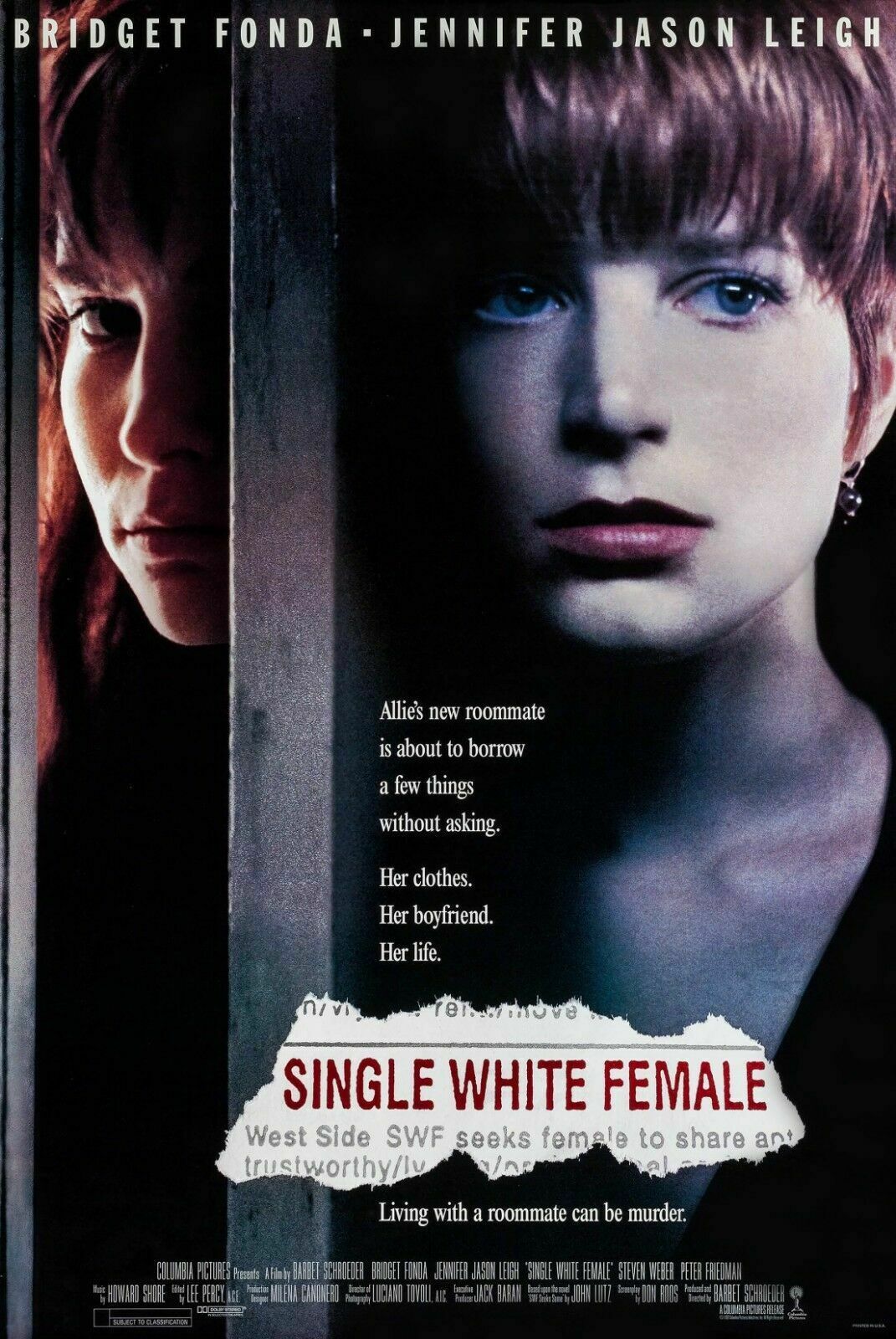
Single White Female

Movie Name: Single White Female
Year of Release: 1992
Director: Barbet Schroeder
Starring: Jennifer Jason Leigh, Bridget Fonda, Steven Weber, Stephen Tobolowski, Peter Friedman, Frances Bay, 
Genre: Drama, Thriller
Score out of ten (whole numbers only): 6
Watch it on Amazon

Synopsis and Review:
French based director Barbet Schroeder started his American directorial career with "Barfly", and quickly established himself with the great "Reversal of Fortune". "Single White Female" was his first big commercial success, written by the talented Don Roos (who would go on to write and direct "The Opposite of Sex" and "Happy Endings"). The film follows the story of Allison Jones, a young woman living in NY, who is currently engaged and about to start her own business (she's a software designer). She finds out her fiancée had a fling with his ex-wife, and decides to cancel all the plans they had together. Due to the new circumstances, she decides to place an add for a roommate. She settles on a quiet and somewhat shy, Hedra Carlson. She quickly learns Hedra had a twin who died when she was a child, and that is an event who scarred her life. The two quickly bond, and Hedy becomes increasingly obsessed with Allie, getting her a dog, and deflecting all attempts of communication her ex-fiancée tries to establish. When Allie and Sam decide to reunite, that causes Hedy to become increasingly territorial and jealous. She decides to stop at nothing to keep Allie all to herself.
Barbet Schroeder manages to illustrate Don Roo's screenplay with a certain flair and aplomb. The relationship between the central characters is slowly built, and while initially there's an air of complicity between both women, they both relish the relationship established for different reasons. At first glance, Allison appreciates the company, devotion and attention Hedra gives her, particularly since she's feeling somewhat fragile following a break up, while for Hedra the relationship is quite different, more of an opportunity to recapture something she lost in the past. When their paths go in different directions, that's precisely where the unbalance from Hedra's behavior starts manifesting itself, and the script takes her in the direction of a psychotic individual, someone who will stop at nothing to get that idyllic relationship she created in her own mind, a reality. Much like Adrian Lynne's "Fatal Attraction", and the central Alex Forrest character, the script loses some of its nuance and power, by making Hedra more of a typical movie villain, as opposed to someone who manipulated, but was also used and equally manipulated in a relationship. There's definitely room for other explorations in this film, but the filmmaking team approached it more from a "Dark Half" type of concept, where Hedra is consumed by her affection, and destroys anything in her path. Both central performances are great, with Bridget Fonda at the time cementing her popularity (she had also done Cameron Crowe's "Singles" and previously Francis Ford Coppola's "The Godfather Part III"), and Jennifer Jason Leigh further establishing herself as the tremendous talent she was already known to be (following her roles in George Armitage's "Miami Blues" and Uli Edel's "Last Exit to Brooklyn"). The production team on this film is superb, including the cinematography from Luciano Tovoli, the score from Howard Shore and costumes & production design from acclaimed Milena Canonero. An entertaining film from an interesting director. 

Friday, April 10, 2020

Raising Cain

Movie Name: Raising Cain
Year of Release: 1992
Director: Brian De Palma
Starring: John Lithgow, Lolita Davidovich, Steven Bauer, Frances Sternhagen, Gregg Henry, Tom Bower, Mel Harris, Teri Austin, Gabrielle Carteris, Barton Heyman, Amanda Pombo
Genre: Drama
Score out of ten (whole numbers only): 6
Watch it on Amazon

Synopsis and Review:
Following the debacle and critical lambasting of "The Bonfire of the Vanities", director Brian De Palma quickly bounced back with a much smaller in scale film, returning to his roots with "Raising Cain". The film follows the story of Carter Nix, a respected child psychologist, who is having marriage issues. He's very focused on his daughter, but more as a research subject. His wife Jenny in the meantime, is having an affair with an ex-boyfriend, something Carter soon discovers. Jenny plans to end the marriage soon enough, but she doesn't realize Carter has multiple personalities, and one of them is a violent one by the name of Cain (he also has the personalities going by the names of Josh and Margo, a nanny). As the Cain personality takes over, he tries to kill Jenny, who survives and confronts him about his deeds, and the whereabouts of Amy, their daughter. As more information is uncovered about Carter/Cain's past, it's revealed he was abused by his father growing up, himself a therapist, who supposedly committed suicide when confronted with his unusual research processes.
"Raising Cain" is a somewhat forgotten film in Brian De Palma's lengthy career. It followed a particularly high profile debacle from "The Bonfire of the Vanities", but it also cemented his comeback, which came in 1993 with the great "Carlito's Way". "Raising Cain" has the DNA of what has made his best films so indelible, namely the multiple personalities who are at dissonance with themselves (something that for instance worked so well in "Dressed to Kill"), and of course, the progressive disclosure and the heightened suspense that the director effectively constructs. "Raising Cain" is somewhat less effective due to the script being less effective, introducing a plethora of personalities, while also making the supporting characters less dimensional and interesting than his most reward films (the fantastic Nancy Allen for instance in both "Dressed to Kill" and "Blow Out" made a strong mark in both narratives, something that Lolita Davidovich, with all her talent, can't do with a somewhat underwritten role). Independently of its shortcomings, a film by Brian De Palma is always enticing, impeccably shot, and this one in particular, as a central performance from the wonderful John Lithgow, always worth watching. A minor effort, but still worth watching, from a great director. 

Sunday, April 5, 2020

Passion Fish

Movie Name: Passion Fish
Year of Release: 1992
Director: John Sayles
Starring: Mary McDonnell, Alfre Woodard, David Strathairn, Vondie Curtis-Hall, Leo Burmester, Angela Bassett, Sheila Kelly, Nora Dunn, Mary Portser, Tom Wright, Jennifer Gardner, Michael Mantell
Genre: Drama
Score out of ten (whole numbers only): 8
Watch it on Amazon

Synopsis and Review:
Director John Sayles may be the perpetual unsung hero of American independent films. He started his career in the late 70s, but really blossomed during the 80s, where he wrote and directed films such as "Lianna", "Matewan" and "Eight Men Out". The 90s started with "City of Hope", quickly followed by this wonderful and little seen "Passion Fish", which popped at the Oscars of 1992 thanks to Mary McDonnell's wonderful performance and Sayles's wonderful script (both of course nominated). The film follows the story of May-Alice, a well known soap opera actress, originally from New Orleans, who is forced to return to her home town, and to her family house, when she suffers a dramatic accident which leaves her paraplegic. Forced to contend with new obstacles, May-Alice resorts to drinking, and goes through an array of nurses, all of which can't deal with her sarcasm, drinking and lack of initiative. That changes when Chantelle is hired. Dealing with her own ghosts of addiction and the consequences of her life choices, Chantelle is determined on keeping afloat and recovering her daughter. She sees May-Alice for who she is, and unlike everyone else, questions her, challenges her, propelling her in a different momentum in life.
"Passion Fish" is a film that manages to be smartly written (and observed), giving two central characters, the opportunity to be more than just a collection of cliches. No matter what their backgrounds or life choices have been, these are two women who live together by force of life circumstances, who learn from occurrences not only of their pasts, but also from their present, accepting all, as they shape the path they want to build for their future. It's the rare script that is filled with drama, but also humor, wit all the while immersing the viewer in the experience of what is living in the American South (Louisiana). In a way, it's the complete opposite of what Barbra Streisand's southern opus, "The Prince of Tides" was about: it's realistic, sentimental without being maudlin, and it provides an authentic look at what the south actually looks like. It's refreshing to witness two lead characters that are flawed, agonizing in a way, and still moving on with their lives, attempting to rebuild, while understanding that the world doesn't stop to assess anyone's pain. That pain exists, becomes part of who you are, and you keep moving forward (or sink in). The performances from all the cast are stupendous, with particular focus on Mary McDonnell and Alfre Woodard, with stellar support from the always fantastic David Strathairn, Leo Burmester and Angela Bassett. The music from Mason Daring is impeccable, as is the cinematography from the incomparable Roger Deakins. A wonderful film always worth revisiting.

Rabid

Movie Name: Rabid
Year of Release: 1977
Director: David Cronenberg
Starring: Marilyn Chambers, Frank Moore, Joe Silver, Howard Ryshpan, Patricia Gage, Susan Roman, Roger Periard, Lynne Deragon, Terry Schonblum, Victor Desy, Julie Anna
Genre: Horror
Score out of ten (whole numbers only): 7
Watch it on Amazon

Synopsis and Review:
Following his celebrated feature film debut with "Shivers", which premiered in 1975, director David Cronenberg quickly followed suit with "Rabid". The film follows the story of Rose, a young woman who, alongside her boyfriend, experiences a motorcycle accident, which leaves her severely injured. She's taken to a nearby clinic for immediate care. The clinic, which specializes in plastic surgery, has an operating team led by Dr. Keloid, who decides to use some new techniques of skin grafting, something they've been testing. While Rose's boyfriend quickly recovers since his injuries were only minor, Rose stays in a coma for a whole month, until she suddenly awakes with an unusual hunger. A fellow patient comes to check on her, and Rose drawn by instinct feeds off of him. As it turns out, the procedure had side effects, that have manifested in a mutation, one that makes Rose need blood to replenish her strengths, as well as she developed this spike that emerges from her armpit, allowing her to feed from her victims. Her victims don't immediately die, but they become carriers of a virus, that drives them insane with rage and lust for blood, which also leads them to die shortly afterwards. As Rose escapes the clinic to head to Montreal, the virus spreads wherever she goes. 
The first part of David Cronenberg's career is populated with films where the writer/director starts exploring a lot of the themes that would run throughout his career in general, and his best films in particular, namely understanding what makes a human being innately human (and how incidents/occurrences shape the perception of what our bodies are). If "Shivers" was in some ways prophetic about the emergence of Aids, "Rabid" is prophetic about pandemic states, in the sense that the virus caused by Rose, just spreads like wild fire. The director is however less interested about the effect that the virus has in society, but more on how Rose adapts her existence to this new condition she has, something that to a certain extent, she's oblivious about. As Rose mutates into something else, her sense of what human is, what that essence and value is all about, also morphs into something quite different. Her new biology dictates more than values or morals: she's driven by hunger, and that trumps everything else. It's a film that once again is prophetic, very pertinent for the times we're living in, and possessed of a unique style that all Cronenberg films had in the late 70s, early 80s (a mix of recognizable reality and a certain futuristic stance). "Rabid" would have benefited from a better central performance, but it's a powerful and entertaining film worth revisiting.

Sunday, March 29, 2020

Pride

Movie Name: Pride
Year of Release: 2014
Director: Matthew Warchus
Starring: Ben Schnetzer, Paddy Considine, George MacKay, Andrew Scott, Imelda Staunton, Bill Nighy, Dominic West, Joseph Gilgun, Jessica Gunning, Faye Marsay, Freddie Fox, Joshua Hill, Chris Overton, Jessie Cave, Menna Trussler, Nia Gwynne, Liz White, Kyle Rees, Johnny Gibbon, Laura Matthews, Russell Tovey, Matthew Flynn, Monica Dolan, Karina Fernandez
Genre: Comedy, Drama
Score out of ten (whole numbers only): 7
Watch it on Amazon

Synopsis and Review:
Celebrated theater director Matthew Warchus directed "Pride" to great acclaim in 2014, following his feature directorial debut in 1999 with the little seen, "Simpatico" (which featured Jeff Bridges, Sharon Stone and Nick Nolte). The film, based on real events, takes place in England, in the mid 80s, during the miners strike. It focuses on a series of characters, initially introducing us to Joe, a closeted 20 year old, who goes to London for the first time to participate in the Gay Pride parade. While there he meets the activist Mark, but also Jonathan and his partner Gethin, who have a bookstore, and Steph, a lesbian activist. Mark is intent on fighting for gay rights, but feels gays should show solidarity to the plight of the miners. This gay group find themselves in the Welsh mining community of Onllwyn, where they start collaborating with them to raise funds and help the families within the community stay afloat while the strike lasts. Even though not everyone is onboard with the help of the gay group, and even tries to sabotage their endeavors, Mark and his team manage to set up a hugely successful benefit concert to which most of the villagers show up, alongside many other attendees, generating quite a hefty load of money. As the strike comes to a closure, some personal news cause some people within the group to have meltdowns, but they manage to reconcile, just as the Pride Parade of 1985 is about to start.
Director Matthew Warchus and writer Stephen Beresford, manage to create with "Pride" a film that is both riveting, humane, humorous, and socially conscious. It tackles both the issues of the miners strike in the 80s, and the strides gay groups were trying to accomplish at the time, when AIDS was decimating and entire generation. It's a film that showcases characters as more than simple archetypes, aiming and deftly demonstrating how everyone can benefit from being compassionate, humane, and having the ability to look beyond their own realities. Even if some of the situations are handled somewhat simplistically, it's nonetheless a film that demonstrates the power of solidarity, of kindness trumping bigotry and discrimination. It's a film that manages to make a powerful statement without being preachy or populist. The entire cast is wonderful, with Bill Nighy, Imelda Staunton, Ben Schnetzer, Andrew Scott, George MacKay, all creating wonderfully vivid performances. Worth watching.  

Pet Sematary

Movie Name: Pet Sematary
Year of Release: 2019
Director: Kevin Kolsch, Dennis Widmyer
Starring: Jason Clarke, John Lithgow, Amy Seimetz, Jete Laurence, Obssa Ahmed, Alyssa Brooke Levine
Genre: Horror, Mystery, Thriller
Score out of ten (whole numbers only): 5
Watch it on Amazon

Synopsis and Review:
After the success of the adaptation of Stephen King's "It", a new array of adaptations of his work has stated to come along. This one in particular, is a new adaptation, since there's a previous version of "Pet Sematary", directed by Mary Lambert, which premiered in 1989. The film follows the story of the Creed family, who move to a new property, in a somewhat rural area, in order to escape the stress of living in a big city. The property they've bought is expansive, and they come to find out through their friendly neighbor Jud, has a Pet Cemetery (which has a plaque with the designation "Sematary"). When the cat's family, by the name of Church, is killed by a passing truck, they decide to not reveal it to their young daughter Ellie. Jud informs Louis there's a way to avoid inflicting the pain of loss on the young girl. He takes Louis to the Pet Sematary and informs him that the locale has special abilities, which allow to bring things back to life. While in discredit, Louis does as Jud indicates, and much to his surprise, Church shows up at the house not much later. While the cat is indeed back, he's not really the same, and while the family is getting familiar with the area, tragedy strikes when Ellie is killed in a car accident. Not wanting to deal with that suffering, Louis takes his daughter's body to the Sematary, in hopes she'll also comes back to life. And she does, just not the same way he expected.
Directors Kevin Kolsch and Dennis Widmyer have had a brief career thus far, mostly specializing in suspense/horror films. Their take on "Pet Sematary" is close in tone to most of the narrative penned by Stephen Kind, save for the final act, which goes in a somewhat different direction. The film and the directors, succeed in building an environment of unease and veiled menace surrounding the cemetery, however, they're less successful in establishing the central characters as more than shallow archetypes for a perfect family. While Louis is a physician, and deeply pragmatic, his wife Rachel, lives with the guilt of feeling responsible for the death of her sister, when she was much younger (her sister suffered from spinal meningitis), and therefore shies away from dealing with that topic (in general and with her children in particular). The character that brings some extra depth and nuance to the proceedings is of course Jud, the friendly neighbor played perfectly by John Lithgow, who unwittingly sets the tragic set of events in motion, when he reveals the power behind the "Sematary". It's a film that doesn't necessarily add much to the previous adaptation, but does manage to feature more polished production values, including the beautiful cinematography from Laurie Rose and the effective score from Christopher Young. While not a bad adaptation, it isn't a memorable one. 

Sunday, March 22, 2020

The Commuter

Movie Name: The Commuter
Year of Release: 2018
Director: Jaume Collet-Serra
Starring: Liam Neeson, Vera Farmiga, Patrick Wilson, Sam Neill, Elizabeth McGovern, Jonathan Banks, Killian Scott, Florence Pugh, Shazad Latif, Andy Nyman, Roland Moller, Ella-Rae Smith, Dean-Charles Chapman, Nila Aalia
Genre: Action, Thriller
Score out of ten (whole numbers only): 4
Watch it on Amazon

Synopsis and Review:
Spanish director Jaume Collet-Serra continues his steady collaboration of films with Liam Neeson, with "The Commuter" being their 4 joint effort (following "Unknown", "Non-Stop" and "Run All Night"). The film follows the story of Michael MacCauley, a 60 year old married man, who previously worked in law enforcement, but is now working as a life insurance salesman. Michael commutes daily into New York/Manhattan, and as the story starts to unfold, we witness his day going progressively worse, as he's let go from his job. Having lost most of his savings and investments from the 2008 recession, losing the job at this point is a particular hardship for him (and his family of course). On his trip back home, he sits across a woman, who introduces herself as Joanna (she also adds she's an academic, someone who studies human behavior). She eventually makes a proposal to him: he'll get 100,000 dollars, if he manages to locate a passenger who doesn't belong on that commute, someone by the name of "Prynne", who has something stolen in their possession. Joanna tells him he has the first tranche of the reward in the bathroom, and the rest will be given to him upon accomplishing the feat. Michael finds the money, and suddenly finds himself in a rapidly escalating situation. Joanna, as it turns out, knows a lot more about him and his family, and blackmails him on their safety, if he doesn't uncover the identity of that passenger, someone who turns out is a witness on a killing that has ties with underground crime and even law enforcement. Michael has to use all his skills and strategy to somehow uncover who the passenger is, keep his family in safe, and avoid being killed in the process.
Liam Neeson has managed to create a career for himself in the past 12 years (in essence since the release of Pierre Morel's "Taken"), as a new and a bit more polished version, of what Charles Bronson was doing in the late 70s and during the 80s with Canon pictures. His characters are typically cut from the same mold: stoic men, with principles, incorruptible, who somehow find themselves in situations that push them to the edge of sanity and moderation. And once pushed far enough, his response comes in the shape of an unleashed fury and violence, that destroys everything in its path. The roles have some slight differences between them, but in essence are somewhat identical, and allow for Neeson to showcase his physicality and charisma, something he always has had as early as can be witnessed in Sam Raimi's "Darkman" for instance. "The Commuter" isn't as formulaic as the "Taken" franchise, since it tries to capture some faint influences from Hitchcock and his "Strangers on a Train", but those influences are quickly discarded in favor of some typical stunts and action set pieces that we've come to expect from these films (and that are also, to a certain extent, influenced by the style, aesthetically and editing perspective, of Paul Greengrass's Jason Bourne films). What barely salvages this film, is indeed its cast, with Liam Neeson finding good support from the always great Vera Farmiga, alongside Patrick Wilson, Jonathan Banks and Sam Neill. The cast makes the film worth watching, but just barely. Forgettable.

Burlesque

Movie Name: Burlesque
Year of Release: 2010
Director: Steve Antin
Starring: Cher, Christina Aguilera, Kristen Bell, Stanley Tucci, Cam Gigandet, Eric Dane, Alan Cumming, Peter Gallagher, Dianna Agron, Glynn Turman, Terrence Jenkins, James Brolin, Julianne Hough, Isabella Hoffman, Michael Landes, David Walton
Genre: Drama, Musical
Score out of ten (whole numbers only): 2
Watch it on Amazon

Synopsis and Review:
After a long career as an actor (he played small but interesting roles in Richard Donner's "The Goonies" and Jonathan Kaplan's "The Accused"), Steve Antin made his directorial debut with "Burlesque". The film follows the story of Ali, a young woman from Iowa, who is working as a waitress, but has dreams of moving to Los Angeles, and going into show business. She finally decides to move forward with the pursuit of her dream, and packs her meager belongings, moving to LA, quickly finding a place to live. She immediately starts looking for places to work, and accidentally discovers a club by the name of Burlesque. Intrigued she goes in, and becomes fascinated by what she sees. She begs for a job with the owner of the club, the charismatic Tess, who initially turns her down. Aiming for a way in, Ali starts waitressing, and finally gets a chance to showcase her dancing moves when one of the dancers becomes pregnant. The club is going through some financial hardship, something that slowly starts turning once Ali starts singing, and the crowds show up. However that's not enough to save the club, and Tess herself from near bankruptcy, that is until Ali figures a solution.
"Burlesque" is a quasi-fantasy musical film, existing in a land located between Rob Marshall's "Chicago" and Baz Luhrmann's "Moulin Rouge". What was so indelible in those two films, besides of course the fantastic performances and production values, was the consistency of its storytelling, and the universe that those filmmakers managed to create and deliver. Sadly with Steve Antin, the film desperately tries to tell the story of a rags to riches of a country girl (whose motivation is never quite made clear), who on the seemingly first day of looking for a job, instantly finds one, and rapid fire succeeds in getting a promotion to a dancing job (again, that's another thing that's never quite expanded upon, Ali's intuitively capability to dance professionally). While these fantastical coincidences aren't necessarily a detrimental factor in a musical, the characters that inhabit this film have little to no dimension, from Cher's club owner, who spends almost the entire narrative trying to save the club, Stanley Tucci's best friend role (and costumer?), who apparently solely exists to be in dressing rooms and behind the drapes, even Christina Aguilera, who after some challenges occur, seems undaunted by anything and whose character is pretty much one note all the time. Even if this film is intended as a fantasy, the odd combination of this superficiality with vague attempts at capturing the entertainment life in LA, seems disjointed and oddly anachronistic. As far as the musical numbers, and personal taste aside, the choreography on display is glitzy and flashy, but the best song of the entire film, comes courtesy of Hope Sandoval and Mazzy Star. This talented cast deserved a better script and more vision of its director. Forgettable.