Sunday, January 9, 2022

Madame

Movie Name:
Madame
Year of Release: 2017
Director: Amanda Sthers
Starring: Toni Collette, Harvey Keitel, Rossy de Palma, Michael Smiley, Tom Hughes, Violaine Gillibert, Stanislas Merhar, Sue Cann, Ariane Seguillon, Brendan Patricks, Tim Fellingham, Josephine de La Baume, Sonia Rolland
Genre: Drama
Score out of ten (whole numbers only): 4
Watch it on Amazon

Synopsis and Review:
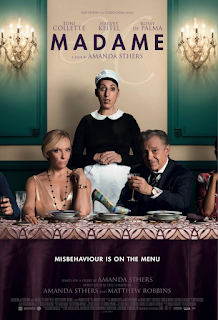
Following her directorial debut with "Je Vais te Manquer", director Amanda Sthers has crafted her follow up, this time collaborating with the well known screenwriter Matthew Robbins (who worked with Steven Spielberg in the 70s, and got his own film produced by Spielberg, "*batteries not included" in the 80s and more recently worked with Guillermo Del Toro on "Mimic" and "Crimson Peak"). The film follows the story of Maria, a maid for a rich American couple currently living in Paris, and trying to stay afloat while navigating some difficult financial times. Anne, the much younger wife of Bob, decides to throw one of her lavish dinners, but Bob at the last minute decides to include his son from a previous marriage, throwing the number of guests into disarray. Anne at the last moment decides to include Maria in the dinner party, much to her reservation and clear objection. During the dinner Maria catches the attention of a British art broker, by the name of David. He is informed by Steven, Bob's son, that she is of Spanish nobility, which only drives his lust further. As their relationship intensifies, and Maria tries to wane it down, Anne becomes increasingly irritated, as she herself navigates a waning marriage, while Bob is pursuing other interests, including other women. As Maria herself navigates this newfound relationship, she soon realizes that feelings are indeed fleeting and that class dynamics are more prevailing than she imagined.
"Madame" is a film that ultimately lives from the ability and magnetism of its performers. It's a film that tries to look at class struggles and what those actually mean in the 21st century, but it fails to bring either a satirical aspect to it, or even a dramatic flair to the relationships that are at its core. It's a film that has a series of commonplace narrative premises, but one that fails to capitalize on the very talented cast who is game for anything the director wants to stage. The relationship between Bob and Anne is never expanded upon, though the fantastic Toni Collette and the always impeccable Harvey Keitel have chemistry and could have built something truly interesting and memorable from that point on. Rossy de Palma who always brings some gravitas and humor to her performances, one only needs to remember "Women on the Verge of a Nervous Breakdown", "Kika" or "The Flower of My Secret", all from Pedro Almodovar, is underused in a role that mostly asks her to be surprised and astounded by the events taking place (she's portrayed more as a victim of the circumstances, never truly seizing her own reigns, only ultimately doing so by the epilogue of the narrative). It's a film that is mostly placid, uneventful, and that fails to ask more pertinent questions about class, relationships, and even the ennui of the privileged. Toni Collette, Harvey Keitel, Rossy de Palma and Michael Smiley are all great in their roles, but they deserved a richer, more gripping and satisfying story. Forgettable.
The Lost Daughter

Movie Name:
The Lost Daughter
Year of Release: 2021
Director: Maggie Gyllenhaal
Starring: Olivia Colman, Jessie Buckley, Dakota Johnson, Ed Harris, Peter Sarsgaard, Paul Mescal, Dagmara Dominczyk, Jack Farthing, Oliver Jackson-Cohen, Panos Koronis, Alba Rohrwacher, Nikos Poursanidis, Robyn Elwell, Ellie Mae Blake
Genre: Drama
Score out of ten (whole numbers only): 5
Watch it on Netflix

Synopsis and Review:
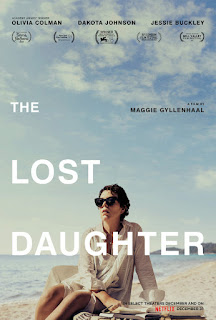
Actress Maggie Gyllenhaal has made her feature directorial debut, with this well received drama, an adaptation of the book by Elena Ferrante. The film follows the story of Leda, a professor whom we meet at the beginning of the film taking a vacation in Greece. She is renting a lovely apartment, and goes to the beach on her own. She soon finds herself surrounded by a series of noisy tourists, a large family with whom she has an early clash. As that relationship is  smoothed over, she is drawn to a woman in that group, the beautiful Nina who has a young daughter. As she observes the dynamics of Nina and her daughter, she recalls her own interactions with both her daughters, and the choices she made when they were growing up. When Nina's daughter momentarily disappears, Leda finds her, bringing the women together. However Leda keeps the little girl's doll hidden in her purse, since she witnessed some bizarre behavior from the little girl, which also reminded her of her daughter's behavior. As Leda continues to become more aware of Nina's relationships, the more she is reminded of her own life and where that has led her.
"The Lost Daughter" is an atypical film, in the sense that it resembles at times films made in the 70s, but without the same emotional or intellectual investment those films had. The film features a professor of literature, who quotes authors both in English and Italian (in different phases of her life as well), who lives in an academic bubble of sorts, which has rendered her somewhat maladjusted to the niceties of living with others outside of that same bubble or for that matter, has disabled her to understand people around her altogether. Her academic prowess has also turned off her ability to read those who surround her, or in some situations, hide her contempt for them. It's a film that is at its best when it lets Olivia Colman and Dakota Johnson interact and shape that ambiguous relationship, one that is tinted by fascination and almost obsession, in the sense that Leda sees in the relationship Nina has with her child, some aspects of herself and her own relationships with her children, but also she witnesses Nina being so much more than she ever was. The flashback scenes with Jessie Buckley are very disconcerting, in the sense that the tribulations with the children are hammered constantly (I'd suggest Gyllenhaal look at Lynne Ramsay's "We Need to Talk About Kevin" to get a sense of how to build that type of environment more effectively), on a persistently same note, and not very elegantly (yes, the girls require attention, and apparently 100% of Leda's time). Also and as the flashback's evolve, we understand Leda's unhappiness, but again seen through a prism that never tells us much about what she actually wants, even from the man she embarks on an affair with (which again seems more casually evolving, more so than emotionally resonant for the character). The film ultimately feels more like an opportunity to check a series of boxes on how to tell a story about a person who isn't necessarily likable, who is intellectually inaccessible, who made her own youthful and some may consider selfish choices, but who is herself on a journey to try to live with those choices and understand where they have led her. The topics are supple and the film is impeccably acted, particularly by Olivia Colman, Dakota Johnson and Ed Harris, it just needs to feel more grounded, less artificial and definitely less like a thesis of someone demonstrating how to do an independent film that is "important". The choice of songs for the score is terrible and distracting (yes, they're in Greece, the score has Greek songs, let's be as obvious as possible), but the cinematography from Hélène Louvart is impeccable. It's a film that tries to be many things, and ultimately a lesson that sometimes, less is definitely more. 

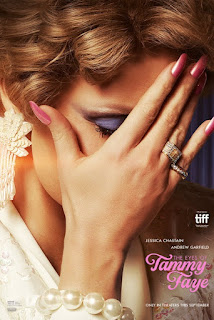
The Eyes of Tammy Faye

Movie Name:
The Eyes of Tammy Faye
Year of Release: 2021
Director: Michael Showalter
Starring: Jessica Chastain, Andrew Garfield, Vincent D'Onofrio, Cherry Jones, Mark Wystrach, Sam Jaeger, Louis Cancelmi, Gabriel Olds, Fredric Lehne, Chandler Head, Dan Johnson
Genre: Drama
Score out of ten (whole numbers only): 3
View Trailer

Synopsis and Review:
Multi talented actor/writer/producer and director Michael Showalter is back, following his breakthrough with the well received "The Big Sick", and his more recent and less successful "The Lovebirds". "The Eyes of Tammy Faye" is based on the solid documentary of the same name from Fenton Bailey and Randy Barbato, who have directed other well known documentaries such as "Inside Deep Throat", "Party Monster" and "Mapplethorpe: Look at the Pictures". The film narrates the life of Tammy Faye LaValley, as she grows up and has her connection with church and religion. In the 60s while studying at a Bible College, she meets Jim Bakker, whom she gets infatuated with, leading to an early marriage, even before she's 20 years old. As they move to South Carolina to begin their ministry, they also start a puppet show on Pat Robertson's Christian Broadcasting Network, which steadily gets them more and more recognition. As their popularity starts soaring, some cracks in their marriage start showing. They eventually start their own program, the PLT Club, which again quickly soars in popularity, allowing them to create their own network, and start funding a series of initiatives, including theme parks, retreats, all with a Christian motif. Tammy in the meantime has two children, continues singing and releasing music, but feels abandoned by Jim, who is always involved in his own business (and other diverse) affairs. As some indiscretions, both from Tammy and Jim catch up with them, the empire they so diligently worked to build starts to cave in.
As I watched this film I was instantly reminded of Gus Van Sant's "Milk", which also had a celebrated documentary sibling, "The Times of Harvey Milk" from director Rob Epstein. I was also reminded how much I loved Gus Van Sant's take on Harvey Milk, since he didn't try to mimic the documentary, he built a narrative around that particular character, and infused the story with a variety of characters which brought both color and dimension to the challenges, loves and ultimate tragic death of that character. It is a film that empathizes with the central character, humanizing it, never falling trap of being condescending or making the character likable or saint-like. "The Eyes of Tammy Faye" is somewhat of a different direction. For all the investment that is placed on rebuilding the world in which these characters live, the film never truly manages to remove this judgmental stance on the characters, almost poking fun at who they are. Somewhere during the process of adapting the documentary to a fictional narrative, something got lost, and what ends up being displayed aren't actual people with longing, challenges, pain or getting through the absurdities of life. The film plays more like an elaborate and glossy film of the week, one that lacks humanity and emotional truth about who Tammy and Jim were at that point in time, what they wanted out of their lives, their relationship and ultimately themselves. It's a bauble of a film, which seems to exist to validate Jessica Chastain's pursuit of more awards (she was far better in Kathryn Bigelow's "Zero Dark Thirty" and even Aaron Sorkin's "Molly's Game"), the same going for Andrew Garfield (who was so good in Martin Scorsese's "Silence" and David Fincher's "The Social Network"). Cherry Jones and Vincent D'Onofrio manage to bring some grit and dimension to the film, but ultimately this a feature that feels superficial, and more shockingly so, unnecessary. 

Sunday, January 2, 2022

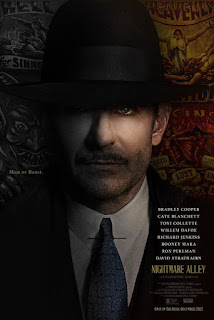
Nightmare Alley

Movie Name:
Nightmare Alley
Year of Release: 2021
Director: Guillermo del Toro
Starring: Bradley Cooper, Rooney Mara, Cate Blanchett, Toni Collette, David Strathairn, Richard Jenkins, Ron Perlman, Willem Dafoe, Mary Steenburgen, Clifton Collins Jr., Tim Blake Nelson, Mark Povinelli, Peter MacNeill, Holt McCallany, Paul Anderson, Jim Beaver, David Hewlett, Lara Jean Chorostecki
Genre: Action, Sci-Fi
Score out of ten (whole numbers only): 7
View Trailer

Synopsis and Review:
After finally winning a series of well deserved awards with "The Shape of Water", director Guillermo del Toro is back, this time around with the adaptation of a book by William Lindsay Gresham, which had previously been adapted to the big screen by Edmund Goulding, with a central performance by Tyrone Power (in 1947). The film follows the story of Stanton Carlisle, whom we first encounter leaving a house which he has set on fire. He moves on and quickly finds himself working for a carnival as a carny. He soon makes friends with the clairvoyant Madam Zeena, who typically works with her alcoholic (and much older) husband Pete. As Stan starts to understand their show, he also becomes acquainted with Pete's more elaborate trick, one that he no longer performs, one which obeys a series of coded messages that have a guidebook with specific instructions, one that essentially plays off as if the performer is indeed a clairvoyant or a person with special skills. Stan is also very much interested in Molly, and comes up with a few clever ideas to enhance her show. When Pete dies, Stan decides to propose to Molly moving away and start an act with what he has learnt from Pete (and his book of instructions). They move to NY, where Stan and Molly finally have a very successful act. In one of their sessions, they're challenged by a woman by the name of Lilith Ritter, a psychologist, who suspects their act is a con. As Stan manages to turn the tables on her, she finally introduces him to judge Kimball, who had hired her originally to verify if Stan was indeed legit or not. Upon visiting Ritter at her office, they embark on an arrangement that has motivations Stan isn't fully aware of.
"Nightmare Alley" is very much a noir, one that while obeying to classic plot points, including the expected backstabbings, still flows effortlessly and with a precision that is a testament to the talent of Guillermo del Toro. Guillermo del Toro is a director with a very specific universe, one that is simultaneously shaped by his origins, but also by his focus on creatures that are while appearing to be monstrous, are in reality possessed of a humanity that far surpasses the characters typically considered human. While "Nightmare Alley" may feel at a first glance, his first film without supernatural elements or monsters, it soon becomes evident, that this universe he constructs, is very much a carnival populated with people on the fringes of society, where indeed the concept of monster or freak does exist. And Stanton falls in line with the series of monsters he typically focuses on: he may not be red tinted as "Hellboy" or blue tinted as the creature from "The Shape of Water", but Stanton is a broken individual trying to fit in,  mimicking what others have done, in order to gain love, acceptance, when he knows that his true nature is much darker than what is apparent to everyone. It's a film populated by humans performing monstrous actions, including Willem Dafoe's Clem, Richard Jenkins' Ezra and even Cate Blanchett's Lilith. It's a universe and a narrative worth embarking on, particularly since the film is so well constructed, featuring a remarkable cast, led by the always solid Bradley Cooper, who once again excels, with excellent support from the luminous Rooney Mara, Cate Blanchett, Toni Collette, David Strathairn, Willem Dafoe, Richard Jenkins and Ron Perlman. The production team is also equally fantastic, including the beautiful cinematography from Dan Laustsen, score from Nathan Johnson and production design from Tamara Deverell. While some audiences will possibly dismiss this as a minor effort from Guillermo del Toro, it's nonetheless a very dark film, with a supple universe worth getting to know. 

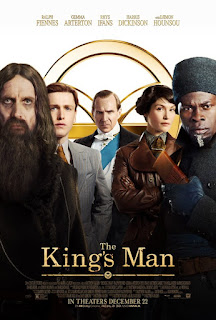
The King's Man

Movie Name:
The King's Man
Year of Release: 2021
Director: Matthew Vaughn 
Starring: Ralph Fiennes, Gemma Arterton, Rhys Ifans, Harris Dickinson, Djimon Hounsou, Charles Dance, Matthew Goode, Tom Hollander, Aaron Taylor-Johnson, Alexandra Maria Lara, Stanley Tucci, Daniel Bruhl, Joel Basman, Todd Boyce, Alexander Shaw, August Diehl, Alison Steadman, David Kross
Genre: Action, Adventure
Score out of ten (whole numbers only): 3
View Trailer

Synopsis and Review:
The "Kingsman" series might have finally hit a snag with this unfortunate sequel from the creative mind of Matthew Vaughn and his collaborator, writer Karl Gajdusek (who also co-wrote Joseph Kosinski's "Oblivion" and some other B-movies, including Roger Donaldson's "The November Man"). This time around the narrative takes us back in time, to the beginning of the 20th century. The Duke of Oxford and his wife, are involved in a humanitarian mission with the Red Cross in South Africa. As the war there is still brewing, they get caught up right in the middle, and Lady Oxford is killed, leaving the Duke with his young son to raise by himself. A few years later, Conrad is almost an adult and wants to go out into the world and explore more, something that his father prevents and tries to shelter him from, as much as possible. When a dark conspiracy from a macabre group sets a series of events in place, resulting and precipitating the First World War, Conrad sees those events as an opportunity to enlist and make a contribution to his country. While his father initially prevents him from doing so, he does enlist his help to go to Russia and thwart the nefarious influence of Rasputin, who controls the Czar's decisions almost entirely. As Conrad becomes legally an adult, he decides to enlist anyway, much against his father's decision who fears for his safety above all. As Conrad fights in the trenches, darker forces are manipulating the players in the War, something the King of England is well aware of, and that he asks the Duke of Oxford help with.
While the previous "Kingsman" films where fairly entertaining endeavors, very much descendants of the James Bond lineage, but with a perspective of their own, particularly due to the material they originate from, namely the comics from Mark Millar, this current chapter decides to tell the story of how everything started, but in the process seems to have forgotten the entertaining factor altogether. The film laboriously and repetitively reinforces the topic that Lord Oxford doesn't want his son to go to war, and that Conrad really does want to go to war. This battle of words between father and son looms over most of the narrative, removing most of the dynamics that touch upon supporting characters, including the typical villain, and even the peers who always appear in spy films and are possessed of quirky personalities or traits. Considering all the time that is spent rehashing the battle between father and son, one would expect that those characters themselves would have some more of a background, or motivation or arc, sadly that's never the case. Lord Oxford and Conrad for that matter, are as enigmatic by the end of the narrative as they are when it first started, the same going for the members on their team (why is Polly an expert in decoding, or for that matter, a spy herself, why is Shola also a secret agent with terrific athletic skills). It's clearly a film from a very skilled director who has a point of view, but this time around, the narrative that has been constructed is simply non existent, giving nothing to the supporting cast to work with, with the notable exception of the episode with Rasputin, which Rhys Ifans gobbles with gusto, but sadly never really goes very far or extends to the remainder of the narrative itself (the main villain while fairly predictable, also has very little to do throughout the entire film). Ralph Fiennes as phenomenally talented as he is, is indeed the sole reason to see this film, but the film doesn't rise up to his talent. The cinematography from Ben Davis is impeccable as is the score from Dominic Lewis and Matthew Margeson and production design from Darren Gilford. A big let down from a clearly talented director who probably needs to pay closer attention to the material he's working with.

Music with an Impact - 2021

2021 in a way seemed like a sequel of the traumatic 2020, but a sequel where everyone's wounds started progressively healing. While the world took a very radical turn in 2020, this past year felt like an attempt at weathering and coming to terms with all that the previous year had shifted in everyone's lives. Many artists who released seminal work had to put their tours on hold, and while some started touring once more in 2021, it was something done in spurts. The year in music for me was comprised of new releases of artists I've known and loved for the past 20 years, but also uncovering work from people I had not heard of before, with albums from quite some time ago. Plenty of great music nonetheless, even if the one produced in 2021 didn't quite resonate (at least not with me). Here's hoping this new year brings more interesting sounds.

Martina Topley Bird - Forever I Wait
St. Vincent - Daddy's Home
Skee Mask - Pool
Charles Webster - Decision Time
Clark - Lisey's Story
Lapalux - Ruinism
Katie Gately - Colors
Stars of the Lid - The Tired Sounds of Stars of the Lid
Tim Hecker - Ravedeath, 1972
Topdown Dialectic - Topdown Dialectic 

More favorites that are not illustrated in the list above.

Photay - On Hold
Seefeel - St / Fr / Sp
Blanck Mass - The Great Confuso EP
Cautious Clay - Blood Type
John Adams - Doctor Atomic Symphony/Guide to Strange Places

Friday, December 31, 2021

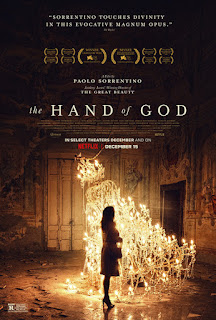
E stata la mano di Dio/The Hand of God

Movie Name: 
E stata la mano di Dio/The Hand of God
Year of Release: 2021
Director: Paolo Sorrentino
Starring: Filippo Scotti, Toni Servillo, Teresa Saponangelo, Marlon Joubert, Luiza Ranieri, Renato Carpentieri, Massimiliano Gallo, Betty Pedrazzi, Enzo Decaro, Sofya Gershevich, Lino Musella, Biagio Manna
Genre: Drama
Score out of ten (whole numbers only): 7
Watch it on Netflix

Synopsis and Review:
Director Paolo Sorrentino has returned, after working on his mini series "The Young Pope/The New Pope" and the films "Loro" (focused on the life of Silvio Berlusconi). The film which takes place in the 1980s, focuses on the life of young Fabietto, who is still in high school, but is focused on soccer, as his most of his hometown of Napoli. The film follows the every day adventures of his extended family, including his loving parents and siblings, but also his uncles and aunts, cousins, grandmother, all of whom have their own dramas taking place. His father and himself, alongside most of the country itself, are very focused in figuring out if Maradona is indeed coming to play soccer to Napoli or not, since they believe him to be touched by the hand of God. When that event happens in 1984, it's a general jubilation, even if Fabietto soon realizes that his idolized father isn't as perfect as he made him up to be. Following a dramatic incident, Fabietto and his family are left wondering what they want to do with their lives, and how they can continue on living.
"The Hand of God" has the ability to immediately invite us to the nest of a close knit family, one where the ties that keep those individuals together are clearly visible. Paolo Sorrentino, who is clearly telling a very autobiographical story, is also very successful at portraying/illustrating life in Italy, specifically in Napoli in the mid 80s, where everything revolved around soccer, the never ending Summers where people went to the beach, danced away and generally speaking, just idly watched life serenely move. It's a film that also carries with it the nostalgia of making films themselves, in this particular case the great Fellini who also influences the narrative being told (and towers over everything in Italy, as far as cinema is concerned of course). As the stories and relationships between the family members become clearer, Sorrentino also demonstrates how youth is sometimes easily influenced, but also easily broken hearted. It's a film that is peppered with humor, tenderness, lust and warmth, that somehow walks a fine line between being very authentic, but also somewhat idealized, though it always remains vibrant and heartfelt. The cast is uniformly excellent, with highlights going to Filippo Scotti and Toni Servillo. The cinematography from Daria D'Antonio is solid as is the music from Lele Marchitelli. Worth watching.

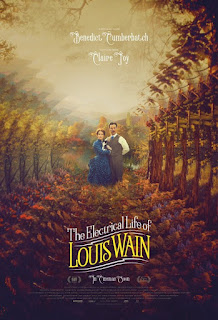
The Electrical Life of Louis Wain

Movie Name:
The Electrical Life of Louis Wain
Year of Release: 2021
Director: Will Sharpe
Starring: Benedict Cumberbatch, Claire Foy, Andrea Riseborough, Toby Jones, Phoebe Nicholls, Stacy Martin, Sharon Rooney, Aimee Lou Wood, Hayley Squires, Adeel Akhtar, Asim Chaudhry, Taika Waititi, Crystal Clarke, Nick Cave, Julian Barratt, Dorothy Atkinson, Olivia Colman
Genre: Drama
Score out of ten (whole numbers only): 5
Watch it on Amazon

Synopsis and Review:
Director Will Sharpe is back, following his work on the show "Flowers" and his previous feature film, the little seen "The Darkest Universe". The film which premiered at the Telluride Film Festival, focuses on the life of British artist, Louis Wain. Louis who was born in 1860, has a large family, which includes 5 other siblings, all girls. While his father had worked in textiles, Louis soon starts making a name for himself as an artist, being able to draw animals and country scenes, working in the process for different publications. He becomes the protege of Sir William Ingram, who while admitting to finding his personality quirky and different, also loves his work. At 23 Louis decides to marry his sisters' governess Emily, something shocking for the time, due to their social differences, and the fact that she was 10 years older than himself. They move to a small house outside of London, while Louis still provides for his mother and sisters, since their father has passed away. However Emily soon becomes ill, threatening their happiness. Around the same time, Emily and Louis decide to adopt a stray cat, and he starts drawing him frequently, which Emily encourages him to publish. As Louis' popularity increases, Emily's health declines and she soon passes away. Due to his lack of business prowess, all of Louis' success and prints provide little revenue, something that shocks his sisters since they're now relying on him alone to provide for the family. Louis decides to go to America and try his talent there, as publishers there have shown interest in his work.
This biopic on the life of the artist Louis Wain, while narratively fairly straightforward, tries to add a layer of difference or quirk, by focusing on a particular aspect of what Wain in the film considers, "the electricity" which runs across everything in life. Whereas Tim Burton's "Big Eyes" for instance focused on the journey of artist Margaret Keane, specifically in reclaiming her own name and reputation on the art market and in society in general, Will Sharpe chooses to detail Louis' journey as somewhat of an innocent person, always seeing the world in a unique manner, particularly more so when he starts capturing cats. As Louis' life goes through its ups and downs, his focus on his art, and making sure his family is provided for is unwavering, even if the outputs of his initiatives are not always the best. It's a film that is sadly fairly generic, considering the universe of this particular artist's life and the controversy which surrounded his later years with same claiming the onset of schizophrenia may actually have been toxoplasmosis (a disease precipitated from cats and their feces), while doctors to this day claiming otherwise. Aside from the central character, the supporting ones get very little dimension to themselves, though the trio of Benedict Cumberbatch, Claire Foy and Andrea Riseborough, all manage to create compelling performances, with good support from Phoebe Nicholls, Stacy Martin and a nice cameo from Nick Cave. The production team is solid, including the cinematography from Erik Wilson and costume design from Michael O'Connor. Watchable but ultimately forgettable.


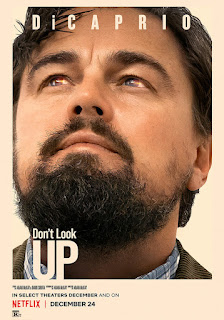
Don't Look Up

Movie Name:
Don't Look Up
Year of Release: 2021
Director: Adam McKay
Starring: Leonardo DiCaprio, Jennifer Lawrence, Rob Morgan, Jonah Hill, Meryl Streep, Cate Blanchett, Timothee Chalamet, Melanie Lynskey, Mark Rylance, Ron Perlman, Tyler Perry, Ariana Grande, Himesh Patel, Michael Chiklis, Tomer Sisley, Robert Joy, Paul Guilfoyle, Conor Sweeney
Genre: Comedy
Score out of ten (whole numbers only): 4
Watch it on Netflix

Synopsis and Review:
Director Adam McKay is back, following his previous film "Vice", which focused on former vice-president Dick Cheney, and featured great performances from both Christian Bale and Amy Adams. This new feature, which Netflix has produced and is releasing, is packed with big name actors and is a broad satire on the greed of the world and corporate malfeasance that is permeating across society. The film focuses on the story of two scientists, Dr. Randall Mindy and Kate Dibiasky. Kate currently working on her PHD, uncovers a meteor hurling towards our solar system, and immediately notifies Dr. Mindy of her discovery. As he makes his calculations in terms of the trajectory of the comet, he and his team come to the horrifying realization that the comet is in fact going to hit Earth, and its impact will destroy life on the planet. They quickly set a plan in motion, which includes notifying the authorities, which eventually gets them in touch with the White House. The leadership of the country is currently under the direction of populist President Orlean, with support of her nonsensical son, and this team takes the news in a much different manner both scientists anticipated. As they devise a plan to destroy the comet, with the cooperation of worldwide governments, things suddenly take a different turn, when the comet is found to have minerals which can boost the profitability of BASH, one of the biggest companies in the world, and a major donor for the current President's campaign. 
Adam McKay has managed to assemble a terrific cast to lead this somewhat blunt satire on American greed, politics and generally speaking, the corporate mercenary type of ideology which seems to dominate not just the American society, but the world in general. The film, which has at its core a very "Armageddon/Deep Impact" type of premise, tries to anchor its narrative on the two scientists who uncover the pending catastrophe, but fails to provide much dimension or much of an arc for what they're actually going through. While both Randall and Kate are supposedly the sensical eyes witnessing the surreality of what is taking place, sadly they're somewhat of a blank canvas, aside from very generic persona/character definition that is assigned to them from early on: Randall is the middle aged scientist, with a rather suburban existence, who gets thrown into the spotlight, is dazzled by the popularity and attention, becomes an endorser for a series of lies, loses his soul, only to somehow redeem himself as the world is coming to an end. Kate is somewhat a no-nonsense student, who detests politics, cares for the environment, but in the process, loses her opportunistic boyfriend and rebels against the political web of lies being crafted, only to find herself pushed out, until she eventually comes to accept the end of it all. Most of the supporting characters are broad satires from well known personalities, including political figures, CEOs, TV Hosts, Entertainers, everyone gets thrown in the massive blender, and yet not one of these characters particularly registers, since they're mostly crafted as puppets. The biggest issue with this film isn't the fact that the situation isn't ripe for satire: it is, and we all understand the players on/of the game. The main issue lies with the fact that in order for this scenario to actually resonate, the characters have to be more than just a collection of tics, and somewhat shocking antics. What we collectively have witnessed in real life has surpassed some of the nonsense that the director has put on display here, so for a satire to be impactful, there needs to be a point of view that is both acidic and corrosive in what it depicts but also humane, in order for us to be moved and humored by what is illustrated. And that requires looking a bit deeper, and showing us more than just the obvious. While the cast is willing to play along, Leonardo DiCaprio who is always so brilliant, is wasted here, the same going for the supporting turns from Cate Blanchett and Meryl Streep, both of whom go very broad in their interpretations of their characters. Jennifer Lawrence manages to remain consistent with her type of characters even if her role is a bit of a waste. The production team is impeccable, including cinematography by Linus Sandgren and score from Nicholas Brittell. While not a terrible film, it's not a particularly memorable one, once again proving that Netflix has an odd track record for what it produces, versus what it buys. 

Sunday, December 26, 2021

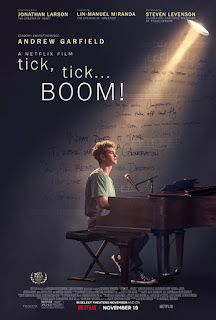
tick, tick... BOOM!

Movie Name:
tick, tick... BOOM!
Year of Release: 2021
Director: Lin-Manuel Miranda
Starring: Andrew Garfield, Alexandra Shipp, Robin de Jesus, Vanessa Hudgens, Joshua Henry, Jonathan Marc Sherman, Michaela Jae Rodriguez, Ben Levi Ross, Judith Light, Bradley Whitford, Laura Benanti, Danielle Ferland
Genre: Drama, Musical
Score out of ten (whole numbers only): 4
Watch it on Netflix

Synopsis and Review:
Lin-Manuel Miranda who of course has made a name for himself on Broadway as the creator of "Hamilton", finally makes his feature directorial debut with "tick, tick... BOOM!", a quasi biopic of Jonathan Larson. Larson, himself an American composer who prematurely passed away at the age of 35 in the mid 90s, just as he was about to experience a grandiose success with "Rent", which went on to win numerous accolades and be a tremendous commercial success. The film introduces us to Larson, as he is working in a diner in Soho, NY, to try to make ends meet, all the while he's continuously writing his musical by the name of Superbia. His girlfriend in the meantime gets offered a teaching position in Massachusetts, and invites him to come along. Some of his friends are also moving on, to jobs in advertising and in the corporate world, since they're tired of living the artist life, with no money, no healthcare, and no future prospects. As Jonathan struggles with finding the inspiration to write a central song to his play, particularly as the play is about to be workshopped, he also has to contend with what he wants out of his future, and his self questioning if he'll ever make it or not.
Modern musicals are a difficult genre to tackle. Essentially because if done well, they can truly soar, and showcase the sometimes surreal mindset of certain characters, such as Bjork's Selma in Lars Von Trier's "Dancer in the Dark". However they can also quickly turn sour, and become a kitschy experience, where essentially the film is like a long videoclip without much to offer in terms of character development or context building, which is the case of Tom Hooper's "Cats" or even Steve Antin's "Burlesque". And then of course, there's the antics of Baz Luhrmann's "Moulin Rouge" which lives in between those two sides of the fence, but that ultimately benefits from the fact that Luhrmann has a very strong point of view, that comes across no matter what. And that is one of the main issues "tick, tick... BOOM!" has: it has a variety of topics that are very important to be aware of, namely the deaths caused by AIDS in the 80s and 90s, the mortgaging of artists' dreams, racism and homophobia, all of which are weighty and have to be handled with some sensitivity. However Lin-Manuel Miranda, for all his ability to illustrate the life of Jonathan Larson, fails to transport the action from whatever doldrum setting the characters find themselves in, to a place where music permeates across everything that it touches. Where Bjork's Selma was influenced by classic films, and imagined herself as part of one, morphing her reality to it, Larson never truly leaves NY, and most of he imagines are meant to illustrate the challenges he's going through to craft his oeuvre. There are some inspired moments throughout the film, but it's overall somewhat tepid, and feels like a rehash of Alan Parker's "Fame" for instance, but without the grittiness or joy that came with it. Ultimately it's a film that lacks that "jump" moment, the moment in which the director asks us to go on this journey with him to his imagination and universe, something Bob Fosse also did in "All That Jazz" for instance. What we're left with, is a nice homage to a talented individual, that is somewhat sentimental, but doesn't necessarily make for an interesting film. The cast is serviceable without being memorable, save for Judith Light, who simply lights any scene she walks into. While it's not a terrible film, it's not a memorable one. 

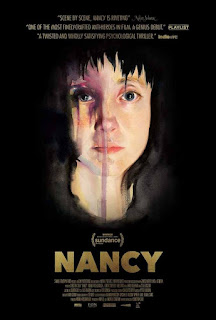
Nancy

Movie Name:
Nancy
Year of Release: 2018
Director: Christina Choe
Starring: Andrea Riseborough, Ann Dowd, J. Smith-Cameron, Steve Buscemi, John Leguizamo, Virginia Kull, Samrat Chakrabarti, T. Sahara Meer, Tibor Feldman
Genre: Drama
Score out of ten (whole numbers only): 7
Watch it on Amazon

Synopsis and Review:
"Nancy" is Christina Choe's feature directorial debut, following a series of shorts that got her noticed in several Film Festivals, including Sundance, where "Nancy" premiered in January of 2018. The film follows the story of Nancy Freeman, a thirty something woman who lives in upstate New York, caring for her mother who has serious health issues. She's an aspiring writer, however all her submissions to get published routinely get declined. After her mother passes away, Nancy sees a news report regarding a couple whose daughter was kidnapped some thirty years ago. When the age progression photo is shown, Nancy notices a vague resemblance, and decides to contact the couple. She mentions to the couple she suspects her mother wasn't actually her birth mother, and that she was in fact kidnapped when she was a child. While the couple initially has some reservations, they eventually ask her to stay, until they can figure out the legitimacy of her claims.
One of the most interesting and compelling arguments to watch this film, lies in the effectiveness with which Christina Choe creates a narrative that envelops us in trying to understand who Nancy actually is. She lives in this ambiguous territory, where we're not entirely sure if she's a swindler, or someone genuinely wanting to connect, or what exactly motivates her. She navigates life without much direction or purpose, aside from her focus on her short stories, so when suddenly the possibility of her life's journey possibly be something quite different than what was originally anticipated, it becomes a very interesting inflection point, both for the narrative, but also for the character herself. This uncertainty, this gray zone in which Nancy operates, makes her a bit of a puzzle, but it's also one of the most riveting aspects of the film. Sadly the third chapter somehow fails to deliver on the premise that the remainder of the film has crafted so well. The film benefits from a wonderful central performance from the underrated Andrea Riseborough, who gets great support from Ann Dowd, J. Smith-Cameron and Steve Buscemi. The cinematography from Zoe White is just desaturated enough to simultaneously illustrate the coldness of the area, but also the barren aspect of Nancy's life itself. It's an insightful and well acted film worth watching.

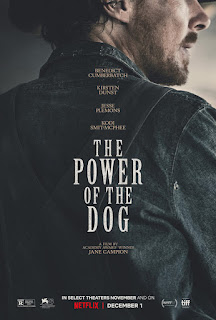
The Power of the Dog

Movie Name:
The Power of the Dog
Year of Release: 2021
Director: Jane Campion
Starring: Benedict Cumberbatch, Kirsten Dunst, Jesse Plemons, Kodi Smit-McPhee, Thomasin McKensie, Genevieve Lemon, Keith Carradine, Frances Conroy, Peter Carroll, Alison Bruce, Alice Englert, Kenneth Radley, George Mason
Genre: Drama
Score out of ten (whole numbers only): 9
Watch it on Netflix

Synopsis and Review:
Director Jane Campion has returned, after her celebrated "Bright Star" and the mini-series "Top of the Lake". "The Power of the Dog" is an adaptation of the novel by Thomas Savage, and focuses its narrative on two ranch owning brothers, Phil and George Burbank. The story which takes place in 1925 in Montana, gains momentum once George falls in love with a widow by the name of Rose, who at the time is running an inn, alongside her young son, Peter. George and Rose soon marry, and Peter goes to college to study medicine. Rose moves to the ranch, and Phil can't hide his dislike of her, treating her rather cruelly. As Rose starts to get affected by these turns of events, a dinner party organized by George further cements her anguish, since she is unable to play the piano as she used to (something that Phil openly mocks her about). By the time Peter comes back to the ranch for Summer break, Rose has become an alcoholic. The meek Peter is openly mocked by everyone on the ranch, but Phil starts paying attention to him, and soon they're developing a closer relationship, which further sends Rose into a downward spiral.  
Jane Campion's films have always been uniquely insightful observations on the roles women play in society, and how patriarchy seemingly tries to box them and fit them into clearly categorized roles. That was something that permeated across "Sweetie", "An Angel at My Table", "The Piano", "The Portrait of a Lady" and even the maligned "In the Cut". In "The Power of the Dog" Ms. Campion turns her attention to a different canvas, namely she has chosen to tackle the roles of masculinity, homosexuality and once more, how they manifest themselves in insecurities and the oppression of femininity (both directly in women and men). It's a particularly rich canvas to work on, since the narrative takes place in the early years of the 20th century, when the advancement of technology, of roles in society, were all rapidly shifting, and at the core of this narrative, is a man who is living within roles he has accepted, but that he fights against. In a way, Peter and his meek and slender appearance, which to some characters in the film render him effeminate, both represent a transgression on these roles, but also the dawn of a new thought process, of an ambiguous way to interpret nature and relate to it. As Peter disrupts Phil's existence, Rose in her role both as a mother and as a female figure of desire, gets shaken to her core, for she too understands how the roles aren't quite as transparent as she initially thought. It's a beautifully rendered film, that slowly unveils itself, with a devastating final chapter, one that the director peppers with sensuality and eroticism, that extends beyond the characters themselves. The cast is uniformly fantastic, with Benedict Cumberbatch possibly crafting one of his most indelible roles thus far, with great support from the wonderful Kirsten Dunst, Jesse Plemons and the quietly unassuming Kodi Smit-McPhee. The cinematography from Ari Wegner is stunning, as is the score from Jonny Greenwood (though it does have "There Will Be Blood" flashes here in there), production design from Grant Major and costumes from Kirsty Cameron. A beautiful film from one of cinema's most uniquely talented voices. 

Saturday, December 25, 2021

Passing

Movie Name:
Passing
Year of Release: 2021
Director: Rebecca Hall
Starring: Tessa Thompson, Ruth Negga, Andre Holland, Alexander Skarsgard, Bill Camp, Gbenga Akinnagbe, Antoinette Crowe-Legacy
Genre: Drama
Score out of ten (whole numbers only): 8
Watch it on Netflix

Synopsis and Review:
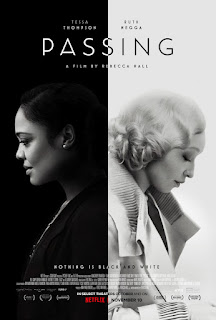
"Passing" is the feature directorial debut from actress Rebecca Hall, who has made a name for herself with solid performances in Woody Allen's "Vicky Christina Barcelona", Christopher Nolan's "The Prestige" and also Antonio Campos' "Christine". This feature, which she also wrote, is the adaptation of the 1929 novel by Nella Larsen, and focuses on the story of Irene and Clare, two women who grew up together, but who have since lost track of each other. They're both mixed-race, but while Irene is married to a Black doctor and lives in Harlem, Clare chooses to "pass" as white, and has married a wealthy white man from Chicago. When they casually meet once again in a hotel in New York City, they suddenly become involved in each other's lives. As Clare starts to engage more and more in Irene's social gatherings and life, she starts suspecting Clare and her husband are having an affair. As Irene tries to cut off contact with Clare, her husband Brian loops her back in, exacerbating Irene's insecurities. Clare in the meantime, as she spends additional time in Harlem, she faces the threat of exposing her racial background, something her husband clearly despises.
There's a quiet assurance to how "Passing" is directed and illustrated, that clearly demonstrates the care and attention Rebecca Hall has devoted in bringing this narrative to life. Irene's life, her ambitions, her habits, are well defined, including her relationship with her husband, and how that also trickles to how they both raise their children, both in terms of activities, but also in terms of topics they choose to expose them to. While Clare as a character remains more enigmatic, it also serves the purpose of the narrative, since Irene never truly understands what Clare's actual intentions are (neither do we as viewers). It's a film that lives from the tapestry of the relationships established between these characters, at a time where racial integration didn't exist, and where people were forced to make challenging choices in order to live and survive. The epilogue of the film is also tremendous, leaving the audience with the responsibility of figuring out what they think happened to the characters. An open ended narrative that somehow feels perfectly in tune with what the film has established. The performances from Tessa Thompson and Ruth Negga are fantastic, and they get great support from Andre Holland, Alexander Skarsgard and Bill Camp. The cinematography from Eduard Grau is stunning as is the score from Devonte Hynes. A very good film worth watching and reflecting upon.

Being the Ricardos

Movie Name:
Being the Ricardos
Year of Release: 2021
Director: Aaron Sorkin
Starring: Nicole Kidman, Javier Bardem, Nina Arianda, J.K. Simmons, Tony Hale, Alia Shawkat, Linda Lavin, Ronny Cox, John Rubinstein, Clark Gregg, Nelson Franklin, Jake Lacy, Ron Perkins, Jeff Holman, Jonah Platt
Genre: Drama
Score out of ten (whole numbers only): 3
Watch it on Amazon

Synopsis and Review:
After the well received "The Trial of the Chicago 7", writer/director Aaron Sorkin is back, this time around tackling a new feature for another streaming giant, Amazon. The film centers around a particularly challenging week in the life of Lucille Ball and her husband Desi Arnaz, as they were going through the taping of their very successful show, "I Love Lucy". The film which takes place in the 1950s, focuses on a week in which Lucille Ball, then riding the wave of popularity due to the success of her show, is being investigated on suspicions of being tied to the Communist party. It's a week where she and her husband Desi, are having relationship issues, since she believes he's being unfaithful, while they're simultaneously working on their upcoming new season of the show (and her possible pregnancy being incorporated into the show). It's a stressful week for everyone, and as they navigate these various challenges, the creative process of getting the show running fluidly creates tension/friction with the writers, show runner, sponsors, other actors, not to mention the Broadcast channel itself.
Aaron Sorkin continues the path of writing and directing narratives centered on actual existing individuals (living or deceased), this time around focusing on the iconic duo of Lucille Ball and Desi Arnaz. Biopics are always challenging, since it can be quite a task to try to compress someone's existence into a 2 hour film. This particular mechanism of focusing on a challenging time on these characters existence, is a way to succinctly illustrate their relationship, but also to do so in a limited timeline. While I personally have to admit I've never watched an episode of "I Love Lucy" or any of her subsequent shows, I had some trepidation going into this film since I do admire Aaron Sorkin's writing, particularly what he did with David Fincher's "The Social Network" and also Danny Boyle's "Steve Jobs". As it turns out, this film fails to both fully capture the relationship between the central characters, but also how they navigate the political and social environment of the 1950s. While the film does have its strong points, particularly when it comes to showcase Lucille's involvement in the creative process of shaping her own show, it also fails to make Lucille a fully fledged character, someone who is more than just a perpetually distressed or annoyed individual. For a film that is about one of the most well known comedians in Hollywood, this film is also devoid of any semblance of humor at all. Both Lucille and Desi are very much reduced to these two players on a game of their own, where one bickers and the other one deflects, never really properly illustrating how they lived together, what held them together, or for that matter, what even kept them going. The supporting cast is a bit more favored in this regard, since J.K. Simmons and Nina Arianda, respectively playing William Frawley and Vivian Vance manage to create more compellingly flawed characters, even if once again their arc is somewhat limited. Nicole Kidman feels somewhat miscast in this role, since for all her efforts, she can't quite evade the "I'm Nicole Kidman playing a role" syndrome, whereas the enormously talented Javier Bardem, simply feels lost in a role where he has very little to do. The sprawling supporting cast, while illustrative fails to create much of a mark, since their onscreen time is so limited, which includes Tony Hale, Alia Shawkat and Clark Gregg. The production team is a solid one, with the beautiful cinematography from the wonderful Jeff Cronenweth, score from Daniel Pemberton and production design from Jon Hutman. While not a terrible feature, it fails to properly register or for that matter, truly capture the varied dimension of such iconic performers. 


The Matrix: Resurrections

Movie Name:
The Matrix: Resurrections
Year of Release: 2021
Director: Lana Wachowski
Starring: Keanu Reeves, Carrie-Anne Moss, Yahya Abdul-Mateen II, Jonathan Groff, Jessica Henwick, Neil Patrick Harris, Jada Pinkett Smith, Priyanka Chopra Jonas, Christina Ricci, Lambert Wilson, Toby Onwumere, Max Riemelt, Joshua Grothe, Brian J. Smith, Erendira Barra, Andrew Lewis Caldwell, Chad Stahelski, Mumbi Maina, Max Mauff, Telma Hopkins
Genre: Action, Sci-Fi
Score out of ten (whole numbers only): 7
View Trailer

Synopsis and Review:
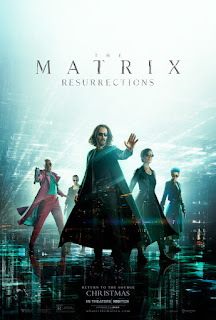
Director Lana Wachowski is back, following her previous projects she worked on alongside her sister Lilly, namely "Jupiter Ascending" and the Netflix show, "Sense 8". This time around Lana, alongside acclaimed novelist David Mitchell (who also wrote "Cloud Atlas", which the Wachowski siblings adapted in 2012 alongside Tom Tykwer) and Aleksandar Hemon, go back to the "Matrix" universe, in order to revisit where Neo, Trinity and all the characters from that iconic cinematic universe are. The narrative introduces us to Thomas Anderson, aka Neo, working as a well known game designer, the one who originally created the popular Matrix game twenty something years ago. The publishing entity which has distributed the game, Warner Bros. wants to go back to that universe, and will do it with Thomas or not. Unbeknownst to Thomas/Neo, the resistance has been trying to locate him in this new version of the Matrix, and when they finally locate him, they have to convince him, that while he indeed died the first time around, he was brought back to this new matrix. And so did Trinity, who has no recollection of anything, and currently goes by the name of Tiffany. As Neo contends to coming back to reality, revisiting old allies and foes, his main focus continues to be saving Trinity, and making sure she's at his side.
Going back to a cinematic staple of the last two decades such as "The Matrix", was always going to be a somewhat interesting task, primarily since the last two chapters of the trilogy, left the arc of many of those characters somewhat resolved. However Lana Wachowski, David Mitchell and Aleksandar Hemon have chosen to go in a very different direction in this sequel, making the characters aware of the previous installments, as if the events of those chapters were themselves part of a game, essentially making the premise for this sequel itself, very meta and self-aware. However as the narrative unfolds, and as Neo progressively witnesses what lies behind this newly built Matrix, it's interesting to witness how Lana Wachowski, while revisiting some familiar elements, also introduces new ones, building upon the pre-existing mythology, namely the meaning of the "one", and what that actually means for the central characters. It's a film that while expanding on a well known universe, does so by un-peeling the different layers that surround this mythology, bringing back some characters such as the Merovingian, who is now suffering its own fate. The action set pieces continue to be very slickly executed, and while the film does continue to falter in terms of building characters that have enough dimension, motivation and a discernible path, it's nonetheless an interesting, unconventional way to revisit a very unique universe. The cast is uniformly solid, with Keanu Reeves and Carrie-Anne Moss leading a group of regular performers who typically work with the Wachowski siblings, including Christina Ricci, Max Riemet, Brian J. Smith, who are aptly aided by Jonathan Groff and Neil Patrick Harris, both of whom are conveniently ambiguous about their intentions. The cinematography from John Toll and Daniele Massaccesi is impeccable as is the score from Johnny Klimek and Tom Tykwer. While it is indeed an uneven endeavor, it's a film that once again dares to think outside the standards, and one that is entertaining and worth seeing.